The science of falling and staying in love
Love is both chemistry (see the previous blog on hormones) and choice — a multidimensional experience shaped by biology, refined by psychology, and enriched by meaning.
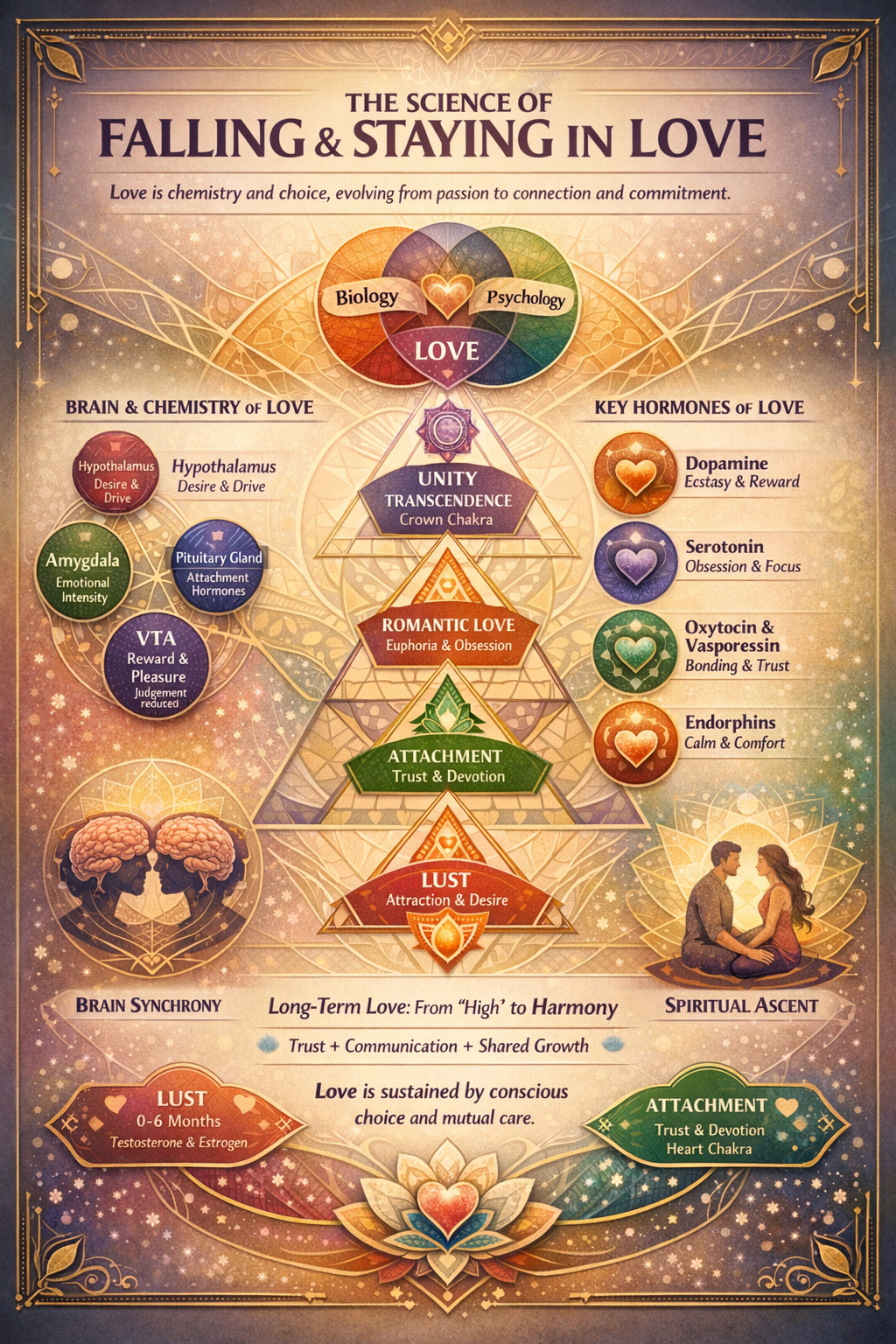
Love activates several parts of the brain, from the primitive to the advanced. A variety of hormones influence love, and some naturally diminish over time.
In fact, the first three years of love resemble a natural hormonal “high” which is not designed to last indefinitely. This stage is primarily instinctive and biologically driven.
To sustain love after the first three years requires what we might describe as the real human qualities. Love flourishes through trust, connection, understanding, and shared meaning.
It is very important to realize that some hormones are biological, while others are bi-directional. For example, the relationship between oxytocin and trust is bidirectional — oxytocin can promote trust, and experiences of trust can stimulate the release of oxytocin. Rather than a simple cause-and-effect relationship, they reinforce one another in a powerful feedback loop.
From a spiritual or symbolic perspective, love is described as an ascent through the cakras - from individuation to union.
The role of the brain
Hypothalamus — initiates desire and releases key neurochemicals.
Amygdala — regulates emotional intensity and reduces fear during romantic bonding.
Pituitary Gland — secretes hormones essential for attachment.
Ventral Tegmental Area (VTA) — activates reward and pleasure circuits.
Prefrontal Cortex — quiets during early-stage infatuation, softening critical judgment.
The role of the hormones
Dopamine — Ecstasy & Reward — Drives pleasure, motivation, and exhilaration.
Serotonin — Obsession & Focus — Decreases in early love, intensifying romantic preoccupation.
Nerve Growth Factor (NGF) — Emotional Intensity - Elevated during the initial stages of romantic attachment.
Oxytocin & Vasopressin — Bonding & Trust- Deepen intimacy, attachment, and long-term connection.
Energetic Resonance
Crown cakra — Unity and transcendence
Heart cakra — Love and compassion
Sacral cakra — Attraction and creative vitality
Stages of love and the associated hormones
Lust (0–6 months): Driven by testosterone and estrogen, fostering physical attraction.
Romantic Love (6 months–3 years): Characterized by dopamine and serotonin, producing euphoria and intense focus. This stage is intensely hormonal and often feels euphoric and consuming.
Dopamine: Creates pleasure, motivation, and excitement.
Serotonin: Decreases, contributing to obsessive thoughts.
Norepinephrine: Heightens energy and focus.
Attachment (3+ years) aka as compassionate love: Sustained by oxytocin and vasopressin, supporting trust, bonding, and long-term commitment. As passion stabilizes, long-term bonding emerges.
Oxytocin: Known as the “bonding hormone,” it fosters trust and intimacy.
Vasopressin: Associated with loyalty and long-term pair bonding.
Endorphins: Produce calm, comfort, and emotional security.
This stage supports enduring relationships, family formation, and social stability.
Scientific Evidence for Long-Term Love
Brain Imaging Studies: Research by Dr. Helen Fisher found that some couples married for over 20 years still exhibit activation in dopamine-rich reward pathways when viewing photos of their partners.
Pair-Bonding Research: Studies demonstrate that oxytocin and vasopressin play a key role in lifelong bonding.
Human Relationship Studies: Long-term relationship satisfaction correlates with empathy, communication, and shared meaning—not just chemistry.
Is long-term love truly possible?
The answer is YES. Science reveals that while hormones ignite love, enduring connection is sustained by attachment, emotional bonding, and conscious commitment.
While passion evolves, enduring love deepens. Scientific studies show that couples married for decades can still exhibit activation in the brain’s reward centers when they see their partners.
What sustains love?
When partners consistently treat each other with care, appreciation, and kindness, the brain adapts by strengthening the neural pathways associated with safety, trust, and emotional reward. Over time, these repeated positive experiences reinforce bonding and deepen attachment. This process is known as positive reinforcement through neuroplasticity—the brain’s ability to rewire itself in response to nurturing interactions.
As these patterns become established, partners begin to exhibit neural synchrony, a state in which their brain activity, emotional responses, and even physiological rhythms align. This synchrony enhances emotional resonance, fosters a sense of unity and connection, and reduces stress and fear by promoting feelings of safety and mutual understanding.
Said simply: kindness rewires the brain, repetition builds trust, synchrony creates connection.
Other key factors include:
Mutual growth
Shared experiences
Communication
Commitment
Respect
Empathy
AI generated image