Hormones — understanding their importance and how to consciously regulate them
Hormones are part of an intelligent, interconnected system that continuously adjusts to both inner physiology and outer experience. Hormones rarely act in isolation. They function within complex regulatory networks involving the brain, endocrine glands, organs, and the nervous system. Most hormonal systems operate through feedback loops, especially negative feedback mechanisms, while many also interact dynamically with behavior and environment in reciprocal ways.
Not all hormones are “bidirectional” in the same sense. Some are regulated mainly through classical endocrine feedback loops, while others are strongly shaped by ongoing interaction between physiology, behavior, emotion, and environment. What matters is not isolated hormonal action, but the larger regulatory system in which each hormone participates.
What does “bidirectional” mean in hormonal terms?
In a broad sense, hormonal bidirectionality can refer to two related but distinct processes:
1. Physiological feedback regulation
Hormones are regulated through internal feedback loops that either reduce or amplify further signaling.
2. Behavioral or psychophysiological reciprocity
A hormone influences behavior, mood, or bodily state, while behavior, experience, and environment in turn influence that hormone’s activity.
These are not identical processes, and distinguishing them helps avoid confusion.
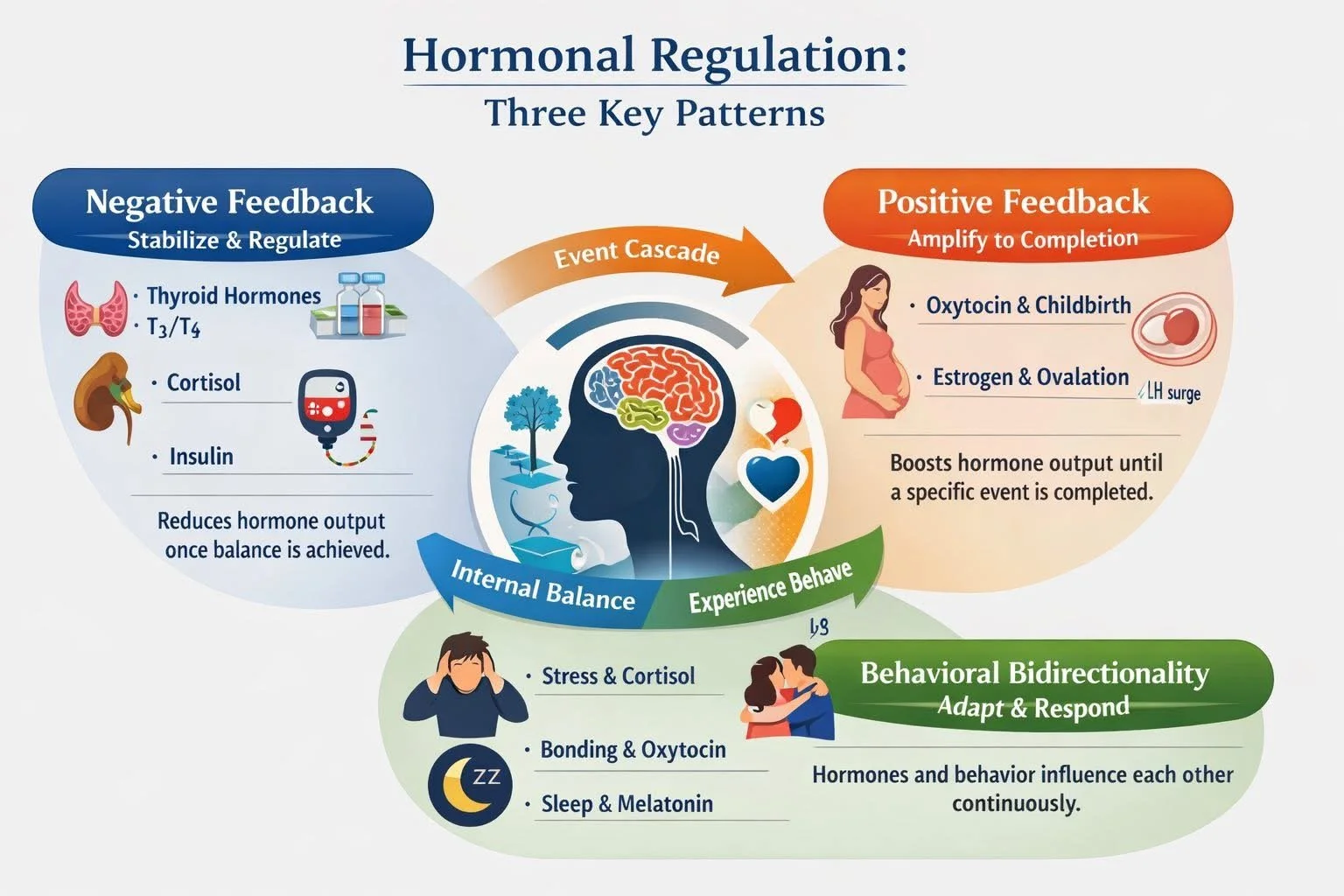
There are three major patterns of hormonal regulation:
1. Negative Feedback (Primary regulatory pattern)
This is the body’s primary stabilizing mechanism. Hormone output is reduced once the desired effect has been achieved.
Purpose: Maintain homeostasis and prevent overproduction. Homeostasis depends on hormonal balance, not isolated hormonal action.
Examples:
Thyroid hormones (T3 and T4): Adequate thyroid hormone levels suppress TSH release.
Cortisol: Feeds back to the hypothalamus and pituitary through the HPA axis.
Insulin: Secretion decreases as blood glucose levels return toward normal.
Even these systems can be indirectly influenced by lifestyle factors such as stress, sleep, diet, and physical activity.
2. Positive Feedback (Specialized and relatively rare)
In this pattern, hormonal signaling amplifies an ongoing physiological process until a specific event is completed.
Purpose: Drive processes that require rapid escalation to completion.
Examples:
Oxytocin: Intensifies uterine contractions during childbirth.
Estrogen: Helps trigger the luteinizing hormone (LH) surge that leads to ovulation.
3. Behavioral or Psychophysiological Bidirectionality (widespread in lived regulation)
Here, hormones influence behavior, emotion, or physiological state, while behavior and experience in turn influence hormone levels. These processes are especially sensitive to psychology, environment, and lifestyle. 3 is very widespread, especially in humans, because behavior, stress, sleep, light, social contact, and environment constantly affect hormonal activity.
Purpose: To create a living two-way bridge between inner physiology and outer experience, allowing the person to adjust, learn, bond, protect itself, and maintain functional balance.
Examples:
Oxytocin: Supports trust, bonding, and empathy; touch and emotional connection can increase oxytocin release.
Cortisol: Mobilizes the stress response; relaxation, meditation, and perceived safety can lower cortisol.
Testosterone: Influences dominance and competitiveness; competitive success can also increase testosterone.
Dopamine: Supports motivation and reward; achievement and anticipated reward stimulate dopamine activity.
Melatonin: Regulates sleep cycles; light exposure strongly influences melatonin secretion.
Serotonin: Contributes to mood and well-being; exercise, sunlight, and healthy regulation can support serotonin activity.
What a human would look like without #3?
Without behavioral or psychophysiological bidirectionality, a human being would still possess hormones, endocrine glands, and basic internal regulation, but would function in a far more rigid and limited way. Negative feedback could still maintain physiological balance, and positive feedback could still drive specific biological events to completion, but the dynamic two-way relationship between experience and physiology would be greatly diminished.
Such a person would be far less shaped by relationships, environment, behavior, and meaning. Love, trust, touch, fear, stress, success, grief, meditation, and social connection would have much less power to alter the hormonal state in an ongoing adaptive way. The body would regulate, but it would not respond to lived experience with the same depth, flexibility, or intelligence.
This would mean reduced emotional plasticity, weaker bonding, flatter motivation, and a diminished capacity for resilience and embodied learning. A person might still think, act, and survive, but the organism would be less able to transform through experience. The bridge between mind and body would be weaker, and the subtle reciprocity through which physiology shapes behavior, and behavior reshapes physiology, would be largely absent.
In that sense, behavioral bidirectionality is one of the foundations of fully human life. It is what allows experience to become biology, and biology to become lived experience. Without it, a human being could still function, but would be far less adaptive, relational, and transformable.
Hormones in animals
All animals regulate internally, many amplify specific processes when needed, and many also hormonally adapt to behavior and environment. The main difference with humans is the degree of complexity. A human, a wolf, and a bird all show these patterns, but humans usually show a far more elaborate version of #3 because cognition, self-awareness, culture, memory, and symbolic meaning all feed back into physiology.
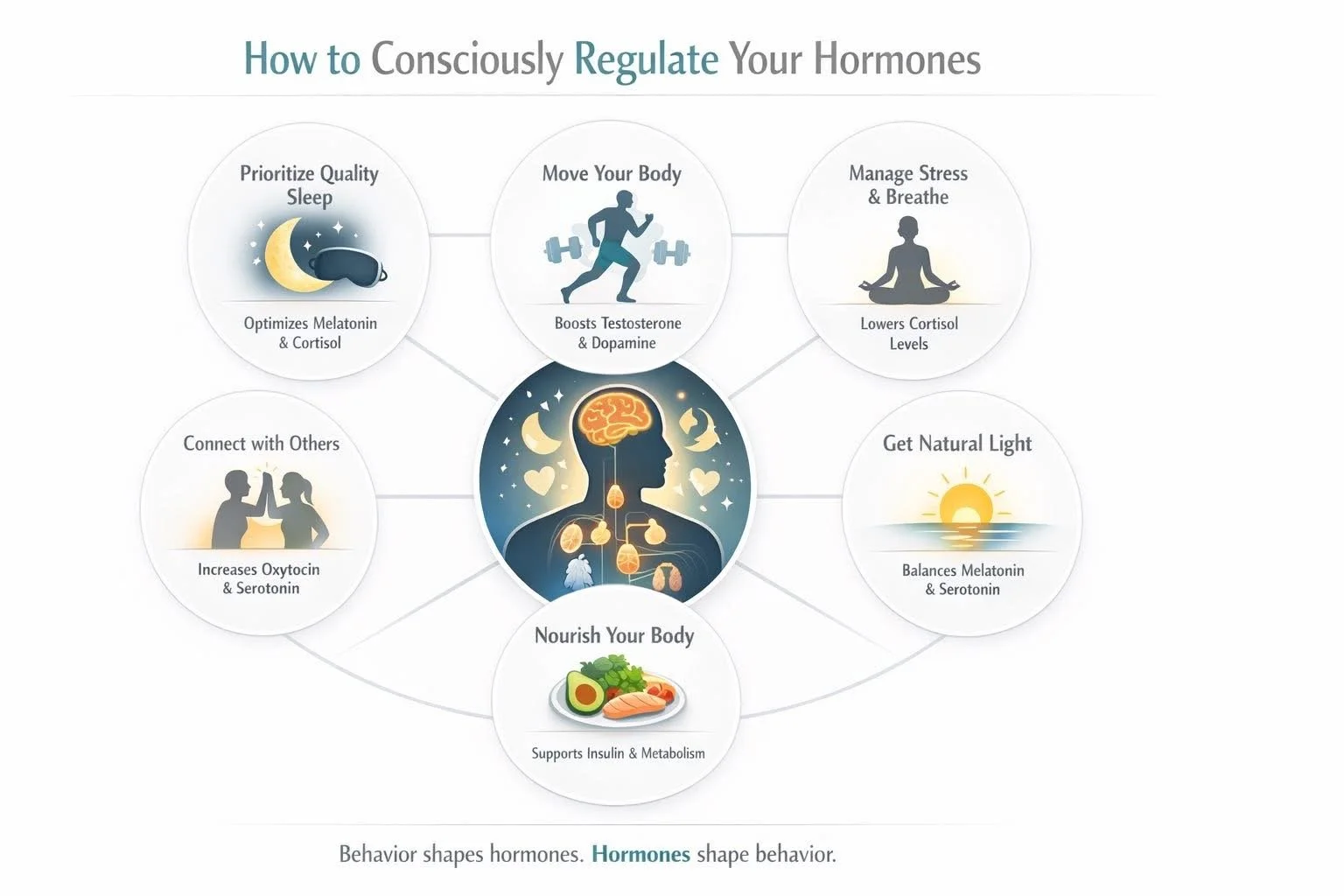
How to Consciously Regulate Hormones
Hormonal regulation is not something you control directly. You influence it through behavior, environment, and physiology — this is exactly #3 (behavioral bidirectionality) in action.
1. Stay Active and Physically Engaged
Regular movement helps regulate multiple systems at once.
Exercise lowers baseline cortisol (stress)
Improves insulin sensitivity (blood sugar balance)
Increases serotonin and endorphins (mood and resilience)
Simple version: Move your body daily → your chemistry adjusts.
2. Practice Relaxation / Meditation
Your nervous system directly controls stress hormones.
Calms the HPA axis (stress system)
Reduces cortisol
Supports serotonin balance
Simple version: Create internal safety → stress hormones decrease.
3. Maintain a Consistent Sleep Cycle
Sleep is one of the most powerful hormonal regulators.
Regulates melatonin (sleep timing)
Balances cortisol rhythm
Supports testosterone, growth hormone, and recovery
Simple version: Stable sleep = stable hormones.
4. Optimize Sunlight Exposure
Light is a primary signal to your endocrine system.
Boosts serotonin (daytime mood)
Regulates melatonin (night rhythm)
Supports vitamin D production
Simple version: Get natural light daily → your internal clock aligns.
5. Eat a Balanced, Stable Diet
Food directly affects hormonal signaling.
Protein and fats support hormone production
Stable meals regulate insulin
Micronutrients support endocrine function
Simple version: Stable nutrition = stable signaling.
6. Foster Positive Social Connection
Human connection is a major hormonal regulator.
Increases oxytocin (bonding, trust)
Boosts dopamine (reward, motivation)
Lowers stress hormones
Simple version: Connection regulates your biology.
The Core Principle
You don’t directly “control” hormones. You shape the conditions, and the body adjusts.
Behavior → Nervous system → Hormones → Experience → Behavior
This is the loop.
Even Simpler
Move
Sleep
Breathe / relax
Get sunlight
Eat well
Connect
Do this consistently, and the system regulates itself.
AI generated image
AI generated image