
Freud's defense mechanisms in romantic relationships
Romantic relationships often bring out the deepest parts of our personality. Love creates closeness, but closeness also activates old fears, childhood wounds, and unconscious ways of protecting ourselves. Sigmund Freud first described these protective strategies as defense mechanisms, and later psychologists expanded and studied them in depth.
Defense mechanisms are not signs of weakness or pathology. They are automatic psychological strategies designed to reduce emotional pain and anxiety. The problem is that what protects us in the short term often damages intimacy in the long term.
Research suggests that people who rely more on immature defense mechanisms experience greater relationship conflict, lower satisfaction, and poorer emotional regulation, while mature defenses are associated with healthier relationships (Vaillant, 1992; Cramer, 2006).
Why couples fight the same fight
Many recurring relationship conflicts are not really about dishes, text messages, money, or sex. They are conversations between unconscious defense mechanisms. One partner says, "Why didn't you text me?" but underneath they mean, "Am I important to you?" The other replies, "Stop being so needy." but underneath they mean, "I'm afraid I'll lose my independence." Neither person is responding to the present moment. They are responding to old emotional blueprints.
The healthier alternative
Instead of explaining, blaming, denying, projecting, or pretending, mature intimacy asks for one simple but courageous act: to let another person see the feelings that the defenses have been trying to hide. That vulnerability is often the beginning of genuine trust, emotional safety, and lasting romantic love.
Research on emotionally focused therapy (Johnson, 2004; Johnson et al., 2013) suggests that secure relationships emerge when partners replace defensive reactions with emotional honesty. Instead of: "Everything is fine." say, "I'm hurt." Instead of: "It's your fault." say, "I'm scared." Instead of: "I don't need anyone." say, "I want to feel close."
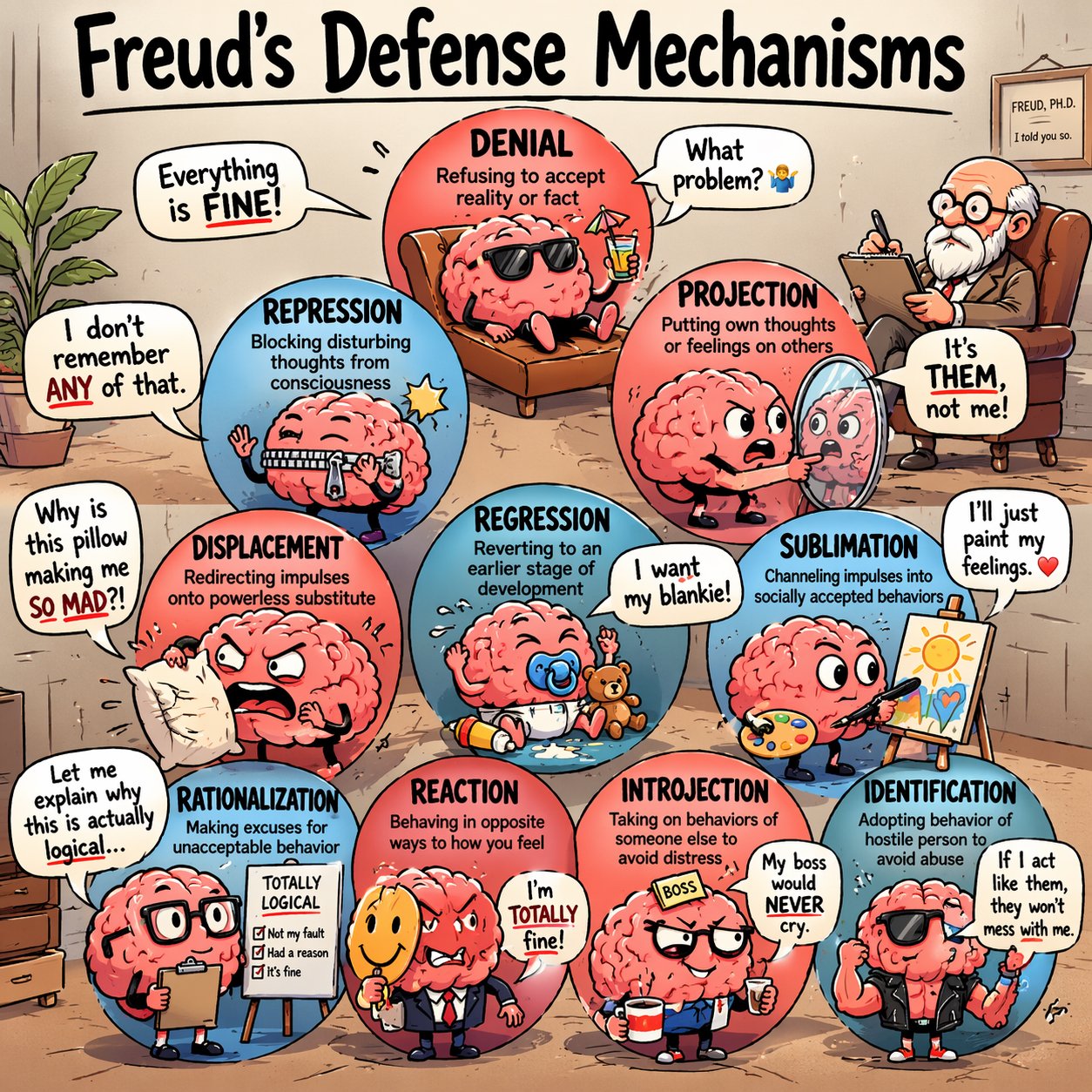
Let’s go through some common examples:
1. Denial: “Everything is fine!"
Denial is refusing to accept reality because acknowledging it would be too painful. Everything is "fine" until the relationship suddenly ends. Research suggests that denial temporarily reduces anxiety but prevents problem-solving and increases long-term relationship distress (Vaillant, 1992).
Example: Sarah notices that her partner has become emotionally distant. Instead of addressing it, she says, "We're just both busy." Months later, she discovers he has already emotionally checked out of the relationship.
2. Repression:” I don't remember ANY of that."
Repression involves unconsciously pushing painful memories or emotions out of awareness. Research on trauma shows that painful emotional experiences may become difficult to consciously access while still influencing present behavior (Andrews et al., 1999).
Example: David becomes extremely anxious whenever his girlfriend asks for commitment. He genuinely cannot understand why. Later in therapy he discovers years of childhood abandonment that shaped his fear of intimacy. The memory disappeared. The emotional pattern remained.
3. Projection: “It's THEM, not me!"
Projection occurs when people attribute their own feelings or desires to someone else. Research links projection with insecure attachment and increased relationship conflict (Baumeister et al., 1998).
Example: Emily feels attracted to a coworker. Instead of recognizing her own feelings, she constantly accuses her husband: "You're probably cheating on me." The accusation reflects her own internal conflict rather than reality.
4. Displacement: “Why is this pillow making me SO MAD?!"
Displacement redirects emotional energy toward a safer target. Research on emotional regulation suggests displaced anger frequently appears in close relationships because they provide a safe outlet (Gross, 1998).
Example: Mike's boss humiliates him at work. He cannot express his anger there. He comes home and explodes because his wife forgot to buy milk. The real target was never the milk.
5. Regression: “I want my blankie!"
Regression means reverting to earlier developmental behaviors during stress. Attachment research demonstrates that stress often activates early caregiving strategies (Bowlby, 1969; Hazan & Shaver, 1987).
Example: An independent adult suddenly becomes clingy after an argument. Instead of saying, "I feel scared you'll leave me," they repeatedly text:"Do you still love me?" "Why haven't you answered?" "Are you mad?" The adult nervous system temporarily falls back into childhood attachment patterns.
6. Sublimation: “I’ll just paint my feelings."
Sublimation channels difficult emotions into constructive activities. Freud considered this one of the healthiest defense mechanisms. Research associates mature defenses such as sublimation with greater resilience and psychological well-being (Vaillant, 1992).
Example: Instead of screaming after a breakup, someone writes music, creates art, runs a marathon, or volunteers. The emotional energy is transformed rather than suppressed.
7. Rationalization: “Let me explain why this is actually logical..."
Rationalization creates believable explanations for emotionally driven behavior. Research shows that self-serving explanations help preserve self-esteem but often interfere with self-awareness and relationship repair (Tavris & Aronson, 2007).
Example: A man ghosts someone after six wonderful dates. Instead of admitting, "I'm terrified of intimacy," he says, "The timing wasn't right." Or, "I'm focusing on myself." The explanation sounds logical while hiding the real fear.
8. Reaction formation: “I’m TOTALLY fine!"
Reaction formation means expressing the opposite of what we truly feel. Research on avoidant attachment shows similar distancing strategies that conceal dependency needs (Mikulincer & Shaver, 2016).
Example: Someone desperately wants closeness but behaves cold and dismissive. Inside: "Please don't leave me." Outside: "I don't need anyone." The behavior protects vulnerability while simultaneously pushing love away.
9. Introjection: “My boss would NEVER cry."
Introjection involves adopting another person's beliefs or behaviors as one's own. Research suggests internal working models formed during childhood strongly influence adult romantic relationships (Bowlby, 1969).
Example: A woman grows up with a father who says, "Real men never show emotion." She later chooses emotionally unavailable partners and criticizes her boyfriend whenever he cries. She is unconsciously carrying someone else's voice inside her.
10. Identification: If I act like them, they won't mess with me."
Identification involves adopting characteristics of a powerful or feared person. Anna Freud described this as identification with the aggressor. Research on intergenerational transmission shows that relationship patterns are often carried across generations unless consciously addressed (Mikulincer & Shaver, 2016).
Example: A man was criticized throughout childhood. He promises himself he will never become his father. Yet years later, during arguments, he hears himself saying exactly the same harsh words to his partner. The behavior that once hurt him becomes the behavior he unconsciously repeats.
References
Andrews, B., Brewin, C. R., Ochera, J., & Morton, J. (1999). Recovering memories of trauma.
Bowlby, J. (1969). Attachment and Loss.
Cramer, P. (2006). Protecting the Self: Defense Mechanisms in Action.
Gross, J. J. (1998). The emerging field of emotion regulation: An integrative review.
Hazan, C., & Shaver, P. (1987). Romantic love conceptualized as an attachment process.
Johnson, S. M. (2004). The Practice of Emotionally Focused Couple Therapy.
Johnson, S. M., et al. (2013). Research on Emotionally Focused Therapy outcomes.
Mikulincer, M., & Shaver, P. R. (2016). Attachment in Adulthood.
Tavris, C., & Aronson, E. (2007). Mistakes Were Made (But Not by Me).
Vaillant, G. E. (1992). Ego Mechanisms of Defense: A Guide for Clinicians and Researchers.
AI generated image