
Growing beyond the myth of “falling in love” into awake, conscious love
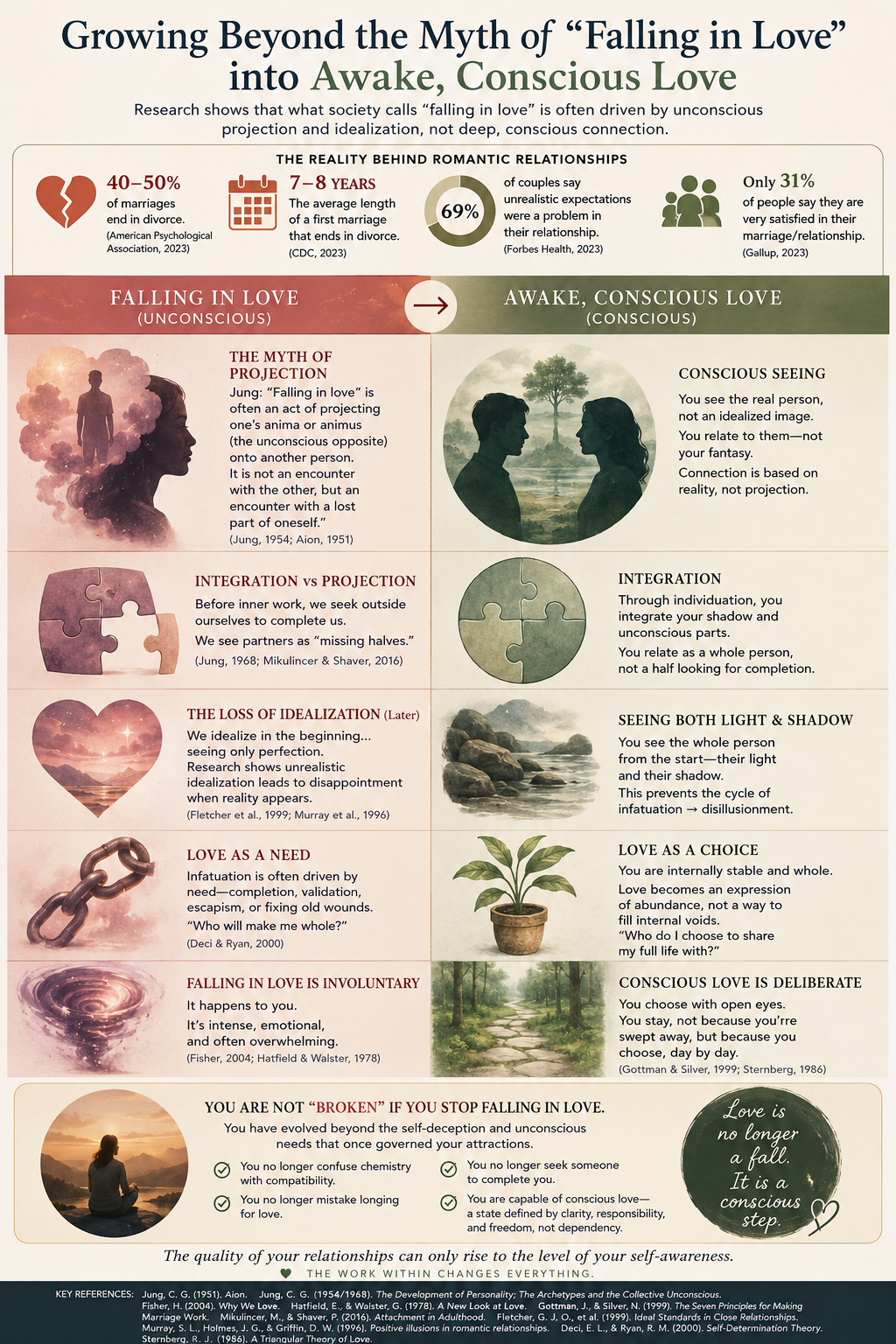
All kinds of research—from relationship studies to divorce statistics—suggest that what society calls “falling in love” is often driven less by deep knowing and a growing conscious connection and more by unconscious attraction patterns, idealization, and projection.
While romantic passion is a real and powerful experience, it is not always the same thing as lasting love (Fisher, 2004; Hatfield & Walster, 1978; Gottman & Silver, 1999).
Carl Jung believed that as people undergo genuine psychological awakening, they often discover that they no longer “fall in love” in the conventional sense.
Instead, as they awake to their own fullness independent of anyone or anything external, they begin to love consciously.
The myth of falling in love
Jung proposed that “falling in love” is frequently an act of projection. We unconsciously project our anima or animus—the hidden feminine or masculine aspects of our own psyche—onto another person and experience them as magical, perfect, or destined.
In many ways, we are not meeting the other person at all; we are encountering a forgotten part of ourselves (Jung, 1954; Jung, Aion, 1951).
This helps explain why the intensity of early romance can feel almost mystical and why it often fades once reality replaces fantasy.
Integration instead of projection
The goal of Jungian individuation is to reclaim these unconscious parts of ourselves rather than searching for them in someone else. As we integrate our shadow, our wounds, and our inner masculine or feminine, the need to complete ourselves through another person gradually diminishes (Jung, 1968).
Modern attachment research echoes this idea. People with greater self-awareness and secure attachment tend to choose partners from a place of authenticity rather than emotional dependency or fear of abandonment (Mikulincer & Shaver, 2016).
You stop looking for someone to save you and start looking for someone to walk beside you.
The end of idealization
One of the surprising consequences of inner growth is losing the ability to idealize others.
Instead of seeing perfection, you see humanity. You notice strengths and flaws at the same time.
This clarity makes the intoxicating highs of infatuation less likely, but it also protects against the painful crash that often follows when reality inevitably appears.
Research on romantic idealization shows that while positive illusions can increase short-term relationship satisfaction, unrealistic idealization eventually gives way to disappointment when expectations collide with everyday life (Fletcher et al., 1999; Murray et al., 1996).
Awareness allows affection to grow without illusion.
Love as a choice, not a need
Infatuation is often driven by a longing for completion or an attempt to escape loneliness, emptiness, or unresolved childhood patterns.
Conscious love arises differently.
It emerges when a person is emotionally grounded and internally stable. Rather than asking, “Who will make me whole?” the question becomes, “Who do I genuinely want to share my already full life with?”
Self-Determination Theory suggests that healthy relationships flourish when they support autonomy, competence, and authentic connection rather than dependency or control (Deci & Ryan, 2000).
Love becomes an expression of abundance instead of a strategy for survival.
Conscious love
Falling in love is largely involuntary. It happens to us.
Conscious love is intentional.
It is choosing someone with open eyes, seeing both their gifts and limitations, and remaining present without needing them to become an idealized fantasy.
This kind of love is less dramatic but often more resilient.
Long-term relationship research consistently finds that friendship, trust, emotional responsiveness, and daily acts of commitment predict lasting satisfaction far better than the intensity of initial passion (Gottman & Silver, 1999; Sternberg, 1986).
Beyond “falling in love”
If you find that you no longer fall in love the way you once did, it does not necessarily mean that you have become cold, cynical, or incapable of intimacy.
It may simply mean that you have outgrown the unconscious patterns that once governed your attractions.
You no longer confuse chemistry with compatibility.
You no longer mistake longing for love.
You no longer seek someone to complete you because you have begun the lifelong work of becoming whole yourself.
From this place, love is no longer a fall.
It is a conscious step.
Selected References
● Carl Jung (1951). Aion: Researches into the Phenomenology of the Self.
● Carl Jung (1954/1968). The Development of Personality; The Archetypes and the Collective Unconscious.
● Fisher, H. (2004). Why We Love.
● Hatfield, E., & Walster, G. (1978). A New Look at Love.
● Gottman, J., & Silver, N. (1999). The Seven Principles for Making Marriage Work.
● Mikulincer, M., & Shaver, P. (2016). Attachment in Adulthood.
● Fletcher, G. J. O., et al. (1999). “Ideal Standards in Close Relationships.”
● Murray, S. L., Holmes, J. G., & Griffin, D. W. (1996). Research on positive illusions in romantic relationships.
● Deci, E. L., & Ryan, R. M. (2000). Self-Determination Theory.
● Sternberg, R. J. (1986). “A Triangular Theory of Love.”
AI generated image