
Separation from the mother wound: how it impacts romantic relationships
This blog expands on the “Separation from the mother: the primal human psychological wound and its impacts” in the context of romantic relationships. Please read that blog first which is in the Spiritual Section for context before delving into this one.
Romantic relationships are one of the most powerful arenas in which the primal wound of separation reveals itself. The infant’s earliest experience with the mother or primary caregiver becomes the template for what love feels like, what closeness means, and what to expect when emotional connection is threatened.
PRE-LANGUAGE PATTERNING
Long before we have language, our nervous system is learning a set of deeply embodied assumptions: “When I reach out, will someone respond?” “When I am distressed, will I be soothed?” “If the person I depend on turns away, will I still be safe?”
These early experiences become what attachment researchers call “internal working models”—unconscious expectations about ourselves and others that shape adult romantic bonds (Bowlby, 1969; Hazan & Shaver, 1987).
When two adults fall in love, they are not bringing only their personalities, values, and life histories into the relationship. They are also bringing the preverbal emotional imprint of their earliest attachment experiences.
Romantic partners often become the most important attachment figures in adult life. The longing to be seen, accepted, soothed, and consistently loved is not merely a cultural fantasy; it is rooted in the same biological attachment system that once connected infant and caregiver (Hazan & Shaver, 1987). In this sense, adult romantic love is deeply linked to the original bond with the mother.
MEANING AND PAIN
For this reason, intimate relationships can feel extraordinarily meaningful and extraordinarily painful. At an unconscious level, a romantic partner may be experienced as the one person who can restore the sense of safety and wholeness that seemed lost when the child first realized, “I am separate.”
When the relationship feels secure, the nervous system relaxes. When the partner becomes distant, critical, unavailable, or inconsistent, old fears of abandonment can be reactivated with surprising intensity. The emotional reaction may seem disproportionate to the present situation because the body is responding not only to the current event but to layers of earlier unresolved attachment distress.
ROMANTIC ATTACHMENT SIMILAR TO CHILDHOOD PATTERNS
Research consistently shows that adults tend to form romantic attachment styles similar to their childhood patterns. Individuals with secure attachment are generally comfortable with intimacy and autonomy.
Those with anxious attachment often fear abandonment and seek constant reassurance. Those with avoidant attachment may suppress their needs and withdraw when relationships become emotionally intense (Mikulincer & Shaver, 2007).
These are not simply personality quirks. They are adaptive strategies that once helped the child manage uncertainty in early relationships.
An anxiously attached partner may become highly sensitive to signs of rejection. A delayed text message, a distracted tone of voice, or a canceled plan may trigger profound feelings of panic. The underlying fear is often not merely “My partner is busy,” but “I am losing the bond that keeps me safe.”
Studies have shown that individuals with attachment anxiety report greater emotional reactivity, jealousy, and preoccupation with relationship stability (Mikulincer & Shaver, 2007; Campbell et al., 2005). Their longing for closeness is genuine, but it can become fused with the desperate hope that another person will eliminate the pain of separateness.
Avoidantly attached individuals often respond in the opposite way. Early experiences may have taught them that emotional dependence is unreliable or overwhelming. As adults, they may value independence and distance, minimizing vulnerability in order to avoid disappointment. Research shows that avoidant individuals tend to deactivate attachment needs, suppress distress, and withdraw when intimacy becomes too intense (Fraley & Shaver, 2000). Although they may appear self-sufficient, this strategy often conceals a deeply conditioned expectation that closeness is unsafe.
One of the most common and painful relationship dynamics occurs when an anxiously attached person partners with an avoidantly attached person. The anxious partner seeks reassurance and connection; the avoidant partner seeks space and emotional regulation through distance. The more one pursues, the more the other withdraws. The more one withdraws, the more the other pursues. This cycle is well documented in attachment research and is associated with lower relationship satisfaction and increased conflict (Pietromonaco & Beck, 2019). Both partners are trying to protect themselves from the original wound, but their strategies inadvertently trigger each other.
BODY IMPACT
The impact of attachment on romantic relationships extends beyond emotional patterns. It affects the body directly. Secure relationships are associated with lower cortisol levels, improved immune function, and better emotional regulation (Diamond & Hicks, 2005). Functional imaging studies suggest that holding the hand of a trusted partner reduces neural responses to threat (Coan, Schaefer, & Davidson, 2006). In other words, a secure romantic bond can literally calm the nervous system. The presence of a loving partner can serve as a form of biological co-regulation, much like a responsive caregiver soothes an infant.
Conversely, relationship insecurity can be profoundly destabilizing. Rejection and perceived abandonment activate brain regions involved in physical pain (Eisenberger, Lieberman, & Williams, 2003). This helps explain why heartbreak can feel physically painful and why emotional disconnection may produce insomnia, appetite changes, anxiety, and even symptoms resembling withdrawal. At a neurobiological level, attachment bonds are not metaphorical; they are deeply embedded in the body’s survival systems.
EXPECTATIONS
The primal wound also shapes the expectations we place on our partners. Many people unconsciously hope that romantic love will permanently remove loneliness, insecurity, and the sense of being fundamentally separate. The partner is cast in the role of rescuer, healer, and source of unconditional validation.
While intimate relationships can be profoundly healing, no partner can fully erase the existential fact of individuality or substitute for inner psychological and spiritual integration. When one person is burdened with the impossible task of completing another, the relationship often becomes strained by dependency, resentment, and unmet expectations.
HEALING
This does not mean that romantic relationships are doomed to repeat childhood pain. On the contrary, they can become one of the most powerful contexts for healing. Research on “earned secure attachment” shows that adults with difficult childhoods can develop greater emotional security through consistent, supportive relationships and reflective self-awareness (Roisman et al., 2002). A partner who responds with empathy, reliability, and emotional attunement can help revise deeply rooted expectations about love and safety.
In healthy relationships, each partner gradually learns that closeness does not require losing oneself, and separation does not mean abandonment. Conflict becomes less threatening because the bond is experienced as durable. Both individuals are free to be autonomous without feeling disconnected. The relationship shifts from a desperate attempt to fill an inner void to a mutual exchange of affection, support, and growth.
From a spiritual perspective, this healing transforms the meaning of romantic love. Instead of seeking another person to complete what feels broken, one approaches relationship from a growing sense of inner wholeness. Love becomes an expression of abundance rather than deficiency. The partner is no longer expected to eliminate all fear or loneliness. Instead, the relationship becomes a meeting between two individuals who can support one another while recognizing that their deepest completeness does not depend solely on the other.
When the primal wound is largely healed, romantic relationships become less possessive and more spacious. Jealousy softens because love is no longer tied to constant reassurance. Emotional intimacy deepens because vulnerability is less threatening. Time apart no longer feels like existential danger. Each partner can appreciate the other as a distinct person rather than as the sole source of safety and worth.
In this way, romantic relationships reveal both the pain of the original separation and the possibility of profound healing. They bring to the surface our oldest fears and our deepest longings. They show us where we still seek rescue and where we can learn trust. When approached consciously, intimate partnership becomes not only a source of companionship but a path toward psychological integration and a more mature experience of love.
Ultimately, the deepest transformation occurs when we stop asking another person to repair our sense of incompleteness and instead allow love to arise from a more stable inner foundation. Then the relationship is no longer driven by the cry, “Do not leave me, or I will fall apart.” It becomes an open-hearted recognition: “I am whole, you are whole, and we choose to share our lives in love.”
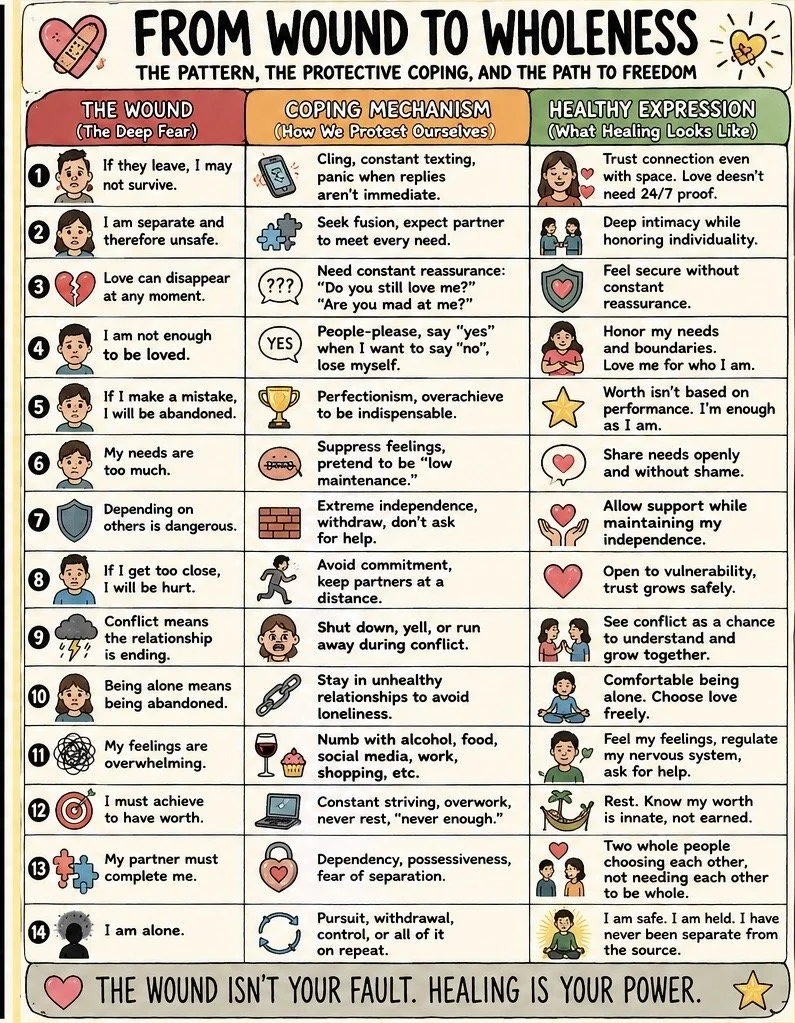
This is a very useful AI generated summary of important related research that is very useful for self-reflection and trauma-release work.
Preverbal/prelanguage trauma
Research on preverbal or prelanguage trauma explores how very early experiences — before a child has words or conscious narrative memory — can still deeply shape the nervous system, emotions, body, and later relationships.
In plain English:
A baby may not be able to “remember” trauma as a story, but the body and nervous system can still remember the experience through patterns of tension, fear, hypervigilance, emotional shutdown, dissociation, or attachment difficulties later in life.
This field combines:
attachment theory,
developmental psychology,
neuroscience,
somatic trauma research,
and infant psychology.
Here are some of the major contributors and ideas:
Bessel van der Kolk — “The Body Keeps the Score”
Bessel van der Kolk official site
Van der Kolk popularized the idea that trauma is often stored in the body and nervous system, not only in conscious memory.
His work showed that traumatic experiences can affect:
stress hormones,
emotional regulation,
body tension,
immune function,
and relationship patterns.
For preverbal trauma specifically:
a child may not remember an event cognitively,
but the body may still react as if danger is present.
Examples:
chronic anxiety,
fear without obvious cause,
emotional numbness,
panic around closeness,
difficulty self-soothing.
Allan Schore — Right Brain Development & Attachment
Allan Schore faculty profile
Schore’s research focused on how early caregiver interactions shape the developing right hemisphere of the brain — the part heavily involved in:
emotion,
attachment,
body regulation,
facial expression,
and stress response.
Key idea:
The infant’s nervous system develops through emotional co-regulation with the caregiver.
If the caregiver is consistently attuned:
the baby develops emotional stability.
If the caregiver is frightening, absent, inconsistent, or emotionally disconnected:
the baby’s nervous system may organize around survival rather than safety.
Schore argues that much early trauma is stored as implicit emotional and bodily patterns rather than explicit memories.
Daniel Stern — The Interpersonal World of the Infant
Daniel Stern overview at Britannica
Stern challenged the idea that babies are psychologically “blank.”
He showed that infants:
are highly relational,
track emotional tone,
sense attunement and misattunement,
and build a preverbal sense of self through interactions.
He emphasized:
facial expression,
rhythm,
tone of voice,
eye contact,
and emotional resonance.
Trauma at this stage may emerge later as:
chronic shame,
difficulty feeling real,
emptiness,
or relational instability.
Peter Levine — Somatic Experiencing
Somatic Experiencing International
Levine focused on how trauma becomes trapped in the nervous system.
His model suggests that trauma is less about the event itself and more about:
the nervous system becoming overwhelmed and unable to complete its survival response.
Preverbal trauma may later appear through:
freeze responses,
chronic muscular contraction,
dissociation,
inability to relax,
or emotional overwhelm.
His work heavily influenced body-based trauma therapies.
Gabor Maté — Early Emotional Environment
Maté emphasizes that infants are extremely sensitive to the emotional state of caregivers.
He argues that chronic stress, emotional absence, suppression of authentic emotion, or insecure attachment can shape:
personality,
disease vulnerability,
addiction patterns,
and emotional coping strategies.
One of his recurring themes:
Children will sacrifice authenticity for attachment.
Meaning:
A child may disconnect from their own emotions or needs in order to preserve connection with caregivers.
Key Scientific Concepts
Explicit vs Implicit Memory
Explicit memory:
conscious story-based memory,
develops later.
Implicit memory:
emotional, bodily, sensory memory,
develops much earlier.
Preverbal trauma is believed to live mainly in implicit memory systems.
Nervous System Imprinting
Early repeated experiences teach the nervous system:
whether the world is safe,
whether closeness is dangerous,
whether emotions are acceptable,
and whether needs will be met.
These patterns can become automatic adult behaviors.
Attachment and Regulation
Babies cannot regulate themselves well alone.
They borrow regulation from caregivers through:
touch,
eye contact,
tone,
rhythm,
presence,
and emotional attunement.
Without enough co-regulation, the nervous system may develop chronic dysregulation patterns.
Common Adult Manifestations Linked to Preverbal Trauma
Researchers and clinicians often associate early preverbal wounds with:
fear of abandonment,
emotional shutdown,
anxious attachment,
avoidance of intimacy,
chronic shame,
dissociation,
people pleasing,
hyper-independence,
panic without clear reason,
difficulty feeling safe,
or inability to fully relax into connection.
Important Nuance
Modern trauma research does not claim:
every adult struggle comes from infancy,
or that all emotional difficulties are caused by parents.
Human development is influenced by:
genetics,
temperament,
environment,
later life experiences,
culture,
and social conditions as well.
Also, many trauma theories are influential clinically but still debated in terms of precise mechanisms and interpretation.
The overall scientific consensus, however, strongly supports the idea that: early attachment and emotional regulation experiences profoundly shape later psychological and relational development.
John Bowlby (1969) — Attachment Theory
John Bowlby proposed that the emotional bond between a baby and its caregiver — usually the mother or primary caregiver — shapes how the person relates to others for the rest of their life.
In plain English:
A child needs safety, love, emotional attunement, and consistency. When those needs are met, the child develops a secure sense of self and trust in others. The child learns:
“I am safe.”
“I am lovable.”
“People can be trusted.”
“Connection is stable.”
But when the caregiver is emotionally unavailable, inconsistent, rejecting, neglectful, or frightening, the child adapts for survival. These adaptations later become attachment patterns in adult life.
Bowlby believed that many adult emotional struggles — fear of abandonment, clinginess, emotional shutdown, anxiety in relationships, difficulty trusting, etc. — often begin in early attachment experiences.
His core idea:
Human beings are biologically wired for connection and emotional bonding.
Hazan & Shaver (1987) — Adult Romantic Attachment
Hazan and Shaver took Bowlby’s ideas and applied them to adult romantic relationships.
Their major insight was:
The way adults behave in romantic relationships often mirrors the attachment patterns they learned as children.
They identified three main attachment styles:
1. Secure Attachment
These people are generally comfortable with intimacy and closeness.
They can:
trust others,
communicate openly,
give and receive love,
handle conflict without panic,
and maintain independence while staying connected.
They usually grew up with relatively consistent emotional support.
2. Anxious Attachment
These people often fear abandonment and crave reassurance.
They may:
overthink texts and interactions,
become clingy,
feel insecure in relationships,
seek constant validation,
or panic when someone pulls away emotionally.
As children, love may have felt inconsistent or unpredictable.
3. Avoidant Attachment
These people often suppress emotional needs and fear dependence.
They may:
avoid vulnerability,
pull away when relationships become too intimate,
appear emotionally distant,
prioritize independence excessively,
or struggle to express feelings.
As children, emotional closeness may have felt unsafe, rejected, or overwhelming.
Why Their Work Became So Influential
Together, Bowlby and Hazan & Shaver helped explain:
why people repeat relationship patterns,
why childhood affects adult love,
why trauma affects connection,
and why healing relationships often requires healing early attachment wounds.
Their work deeply influenced:
psychology,
trauma therapy,
couples counseling,
parenting approaches,
and modern discussions about emotional intimacy and nervous system regulation.