
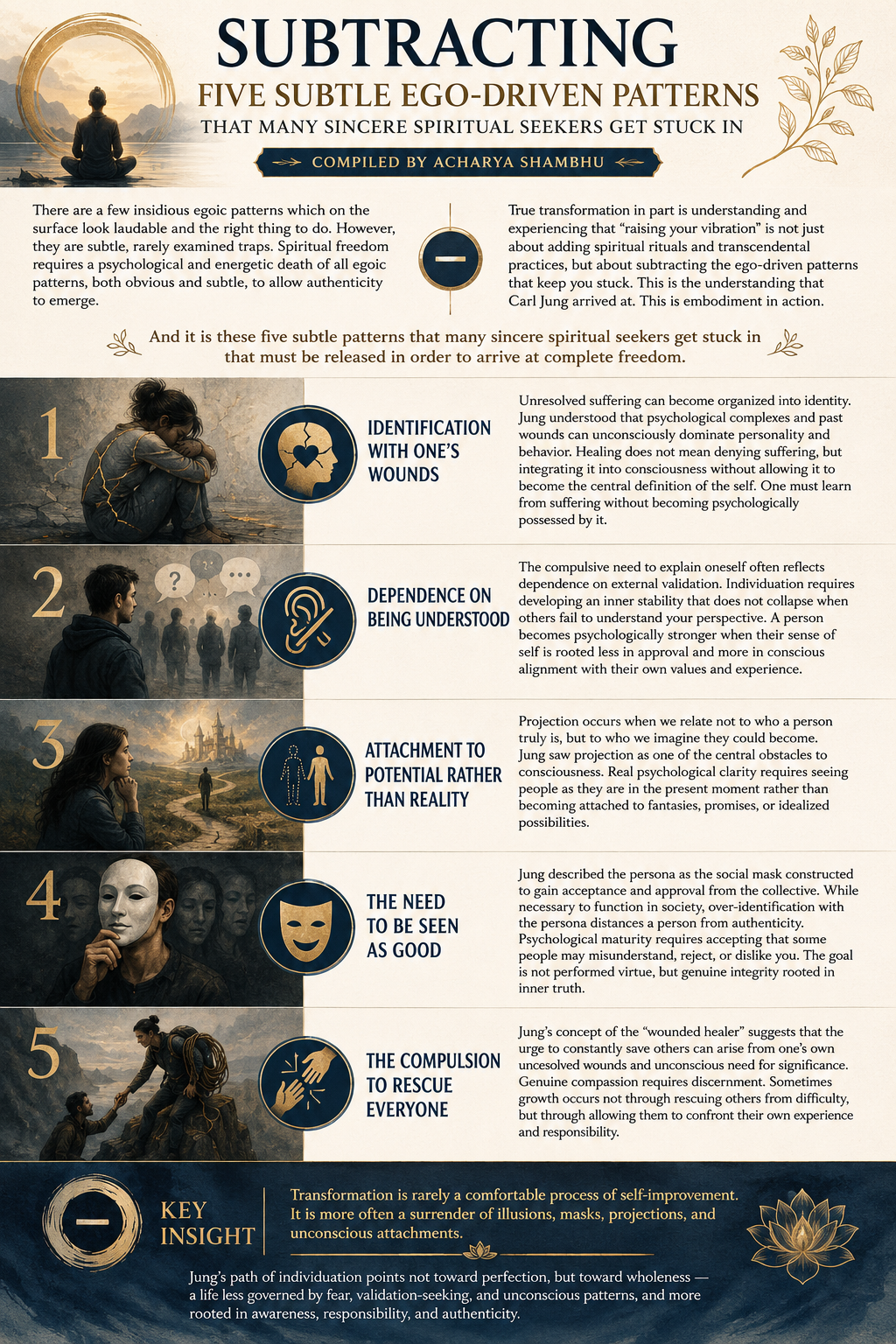
Subtracting five subtle ego-driven patterns that many sincere spiritual seekers get stuck in
There are a few insidious egoic patterns which on the surface look laudable and the right thing to do. However, they are subtle, rarely examined traps. Spiritual freedom requires a psychological and energetic death of all egoic patterns, both obvious and subtle, to allow authenticity to emerge.
True transformation in part is understanding and experiencing that "raising your vibration" is not just about adding spiritual rituals and transcendental practices, but about subtracting the ego-driven patterns that keep you stuck. This is the understanding that Carl Jung arrived at. This is embodiment in action.
And it is these five subtle patterns that many sincere spiritual seekers get stuck in that must be released in order to arrive at complete freedom.
Identification with one’s wounds
Unresolved suffering can become organized into identity. Jung understood that psychological complexes and past wounds can unconsciously dominate personality and behavior. Healing does not mean denying suffering, but integrating it into consciousness without allowing it to become the central definition of the self. One must learn from suffering without becoming psychologically possessed by it.
Dependence on being understood
The compulsive need to explain oneself often reflects dependence on external validation. Individuation requires developing an inner stability that does not collapse when others fail to understand your perspective. A person becomes psychologically stronger when their sense of self is rooted less in approval and more in conscious alignment with their own values and experience.
Attachment to potential rather than reality
Projection occurs when we relate not to who a person truly is, but to who we imagine they could become. Jung saw projection as one of the central obstacles to consciousness. Real psychological clarity requires seeing people as they are in the present moment rather than becoming attached to fantasies, promises, or idealized possibilities.
The need to be seen as good
Jung described the persona as the social mask constructed to gain acceptance and approval from the collective. While necessary to function in society, over-identification with the persona distances a person from authenticity. Psychological maturity requires accepting that some people may misunderstand, reject, or dislike you. The goal is not performed virtue, but genuine integrity rooted in inner truth.
The compulsion to rescue everyone
Jung’s concept of the “wounded healer” suggests that the urge to constantly save others can arise from one’s own unresolved wounds and unconscious need for significance. Genuine compassion requires discernment. Sometimes growth occurs not through rescuing others from difficulty, but through allowing them to confront their own experience and responsibility.
Key insight
Transformation is rarely a comfortable process of self-improvement. It is more often a surrender of illusions, masks, projections, and unconscious attachments.
Jung’s path of individuation points not toward perfection, but toward wholeness — a life less governed by fear, validation-seeking, and unconscious patterns, and more rooted in awareness, responsibility, and authenticity.
AI generated image