
Defense mechanisms in spiritual growth
Spiritual growth is often described as becoming more conscious, more loving, and more authentic. Yet one of the greatest obstacles to awakening is not the external world but the unconscious strategies we use to avoid seeing ourselves.
Freud called these strategies defense mechanisms. Carl Jung saw them as unconscious complexes. Modern psychology understands them as automatic ways of regulating emotional pain. Every spiritual tradition speaks of them in different language: ego, ignorance, conditioning, mental impressions (saṃskāras), automatic tendencies (vāsanās), illusionn(māyā), etc.
None of these mechanisms are “bad.” They once protected us. But eventually what protected the personality begins to imprison the soul.
True spiritual growth is not about becoming someone new. It is about gradually removing the defenses that prevent us from experiencing what is already here and who we really are.
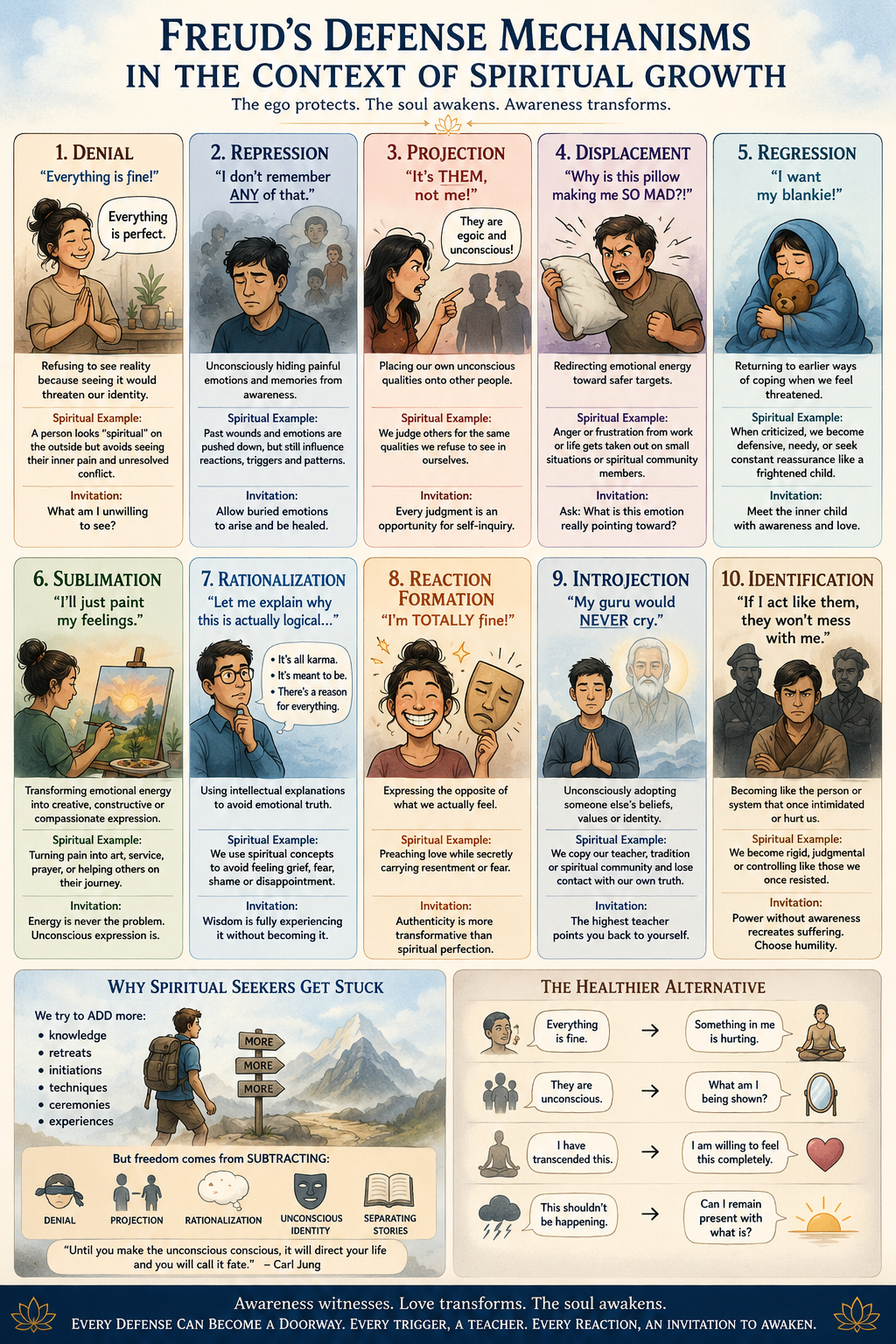
Why spiritual seekers get stuck
Many people believe awakening is about accumulating more knowledge, more retreats, more initiations, more techniques, more ceremonies, more crystals, or more experiences.
Yet every authentic tradition points in the opposite direction. Freedom comes less from adding and more from subtracting. Subtracting denial. Subtracting projection. Subtracting rationalization. Subtracting unconscious identity. Subtracting the stories that separate us from direct experience. Subtracting illusion. Subtracting the veils of duality: doership, difference, separation.
As Carl Jung famously observed,, “Until you make the unconscious conscious, it will direct your life and you will call it fate.”
From the point of view of oneness, there is never subtraction or addition, yet at the level of the individual stuck in duality, subtraction of the levels of ignorance can be an important fuel for growth. In my experience, it is extremely rare for a seeker to rise above and bypass this level of inner work and drop permanently into oneness. The karmic weight for most of us requires the conscious surrender of layers of karmic defense mechanisms. Therefore, defense mechanisms are doorways into freedom.
Let’s go through some examples:
1. Denial: “Everything is fine!”
Denial is refusing to see reality because seeing it would threaten our current identity. Research suggests that denial can temporarily reduce anxiety but ultimately delays adaptation and personal growth (Vaillant, 1992).
Example: A person meditates every day, attends retreats, and posts inspirational quotes. Meanwhile, they are exhausted, resentful, and disconnected from their family. When asked how they are doing, they smile: “Everything is perfect.”
The spiritual path has become a way of avoiding reality instead of meeting it.
Invitation: Replace: “Everything is fine.” with “What am I unwilling to see?” Awakening begins where denial ends.
2. Repression: “I don’t remember ANY of that.”
Repression unconsciously hides painful emotions and memories from awareness. Research shows that unresolved emotional experiences continue to influence behavior even when they are outside conscious awareness (Andrews et al., 1999).
Example: Someone experiences deep stillness during meditation but repeatedly becomes triggered by criticism. They insist, “I have transcended the ego.” Yet every disagreement produces anger or shame. The memories may be forgotten. The body still remembers.
Invitation: Instead of escaping into transcendence, allow buried emotions to arise,
be witnessed, and integrated into consciousness.
Healing is inclusion, not avoidance.
3. Projection: “It’s THEM, not me!”
Projection places our own unconscious qualities onto other people. Carl Jung believed projection is one of the greatest obstacles to individuation because we see outside what actually lives inside.
Example: Someone constantly complains, “Everyone around me has such a big ego.” “Nobody is conscious.” “People are asleep.”
Every person becomes a mirror reflecting the qualities they refuse to acknowledge within themselves.
Invitation: Every judgment becomes an inquiry: “Where does this live in me?” The world becomes less an enemy and more a mirror.
4. Displacement: “Why is this pillow making me SO MAD?!”
Displacement redirects emotional energy toward safer targets.
Example: Someone suppresses frustration during work. They arrive at a meditation retreat expecting peace. Instead, they become irritated because someone is breathing too loudly. Or because the tea is cold. Or because another participant took “their” cushion. The anger was never about the cushion. Meditation simply removed the distractions that had been hiding it.
Invitation: Rather than acting out, sit quietly and ask: “What is this emotion really pointing toward?”
5. Regression: “I want my blankie!”
Regression returns us to earlier ways of coping when we feel threatened. Attachment research demonstrates that stress activates early developmental patterns (Bowlby, 1969).
Example: After years of practice, a respected teacher receives criticism online. Suddenly they become defensive, seek validation, or desperately need students to reassure them. Underneath the spiritual identity is a frightened child asking, “Am I still loved?”
Invitation: Meet the inner child with awareness rather than shame. Every regression is an opportunity for integration.
6. Sublimation: “I’ll just paint my feelings.”
Sublimation transforms emotional energy into creative and compassionate expression. Freud considered this one of the healthiest defense mechanisms, and research associates mature defenses with greater well-being (Vaillant, 1992).
Example: Instead of suppressing grief, someone writes poetry. Instead of acting out anger, they build a community garden. Instead of fighting anxiety, they create music, serve others, or deepen their meditation. The same energy becomes compassion rather than suffering.
Invitation: Energy is never the problem. Only unconscious expression is.
7. Rationalization: “Let me explain why this is actually logical…”
Rationalization uses intellectual explanations to avoid emotional truth.
Example: Someone says, “Everything happens for a reason.” “It’s all karma.” “The universe wanted this.” These statements may be true philosophically. But sometimes they are being used to avoid feeling grief, loss, fear, or disappointment. The mind explains. The heart remains untouched.
Invitation: Wisdom is not thinking about pain.
Wisdom is fully experiencing it without becoming it.
8. Reaction Formation: “I’m TOTALLY fine!”
Reaction formation expresses the opposite of what we actually feel.
Example: Someone constantly speaks about unconditional love, yet secretly carries resentment. They preach surrender, yet desperately try to control every outcome. They smile continuously, while depression quietly grows underneath. The spiritual mask hides the authentic human experience.
Invitation: Real spirituality does not require constant positivity. Authenticity is more transformative than perfection.
9. Introjection: ”My guru would NEVER cry.”
Introjection means unconsciously adopting someone else’s beliefs or identity. Research on internal working models demonstrates how external figures become internal guides shaping behavior (Bowlby, 1969).
Example: A student begins speaking exactly like their teacher. They copy the clothes, the vocabulary,the philosophy, the posture, even the laughter. Eventually they no longer know what is genuinely their own experience.
Invitation: The highest teacher points you back to yourself, not toward becoming a copy of them.
10. Identification: “If I act like them, they won’t mess with me.”
Identification involves becoming like the person or system that once intimidated us.
Example: Someone joins a spiritual community seeking freedom. Years later, they become rigid, judgmental, and dogmatic, using exactly the same fear and control that once oppressed them.
The victim unconsciously becomes the enforcer.
Invitation: Power without awareness recreates suffering. True authority expresses humility.
Key takeaway
The ego defends. The personality reacts. Awareness witnesses. Witnessing becomes presence and repose. And from that emerges a deeper identity—not the constructed self that must constantly protect itself, but the quiet, spacious presence that every contemplative tradition points toward.
Spiritual growth, then, is not the perfection of the personality. It is the gradual recognition that every defense mechanism can become a doorway, every trigger a teacher, and every unconscious reaction an invitation to awaken more fully to who we already are.
AI generated image