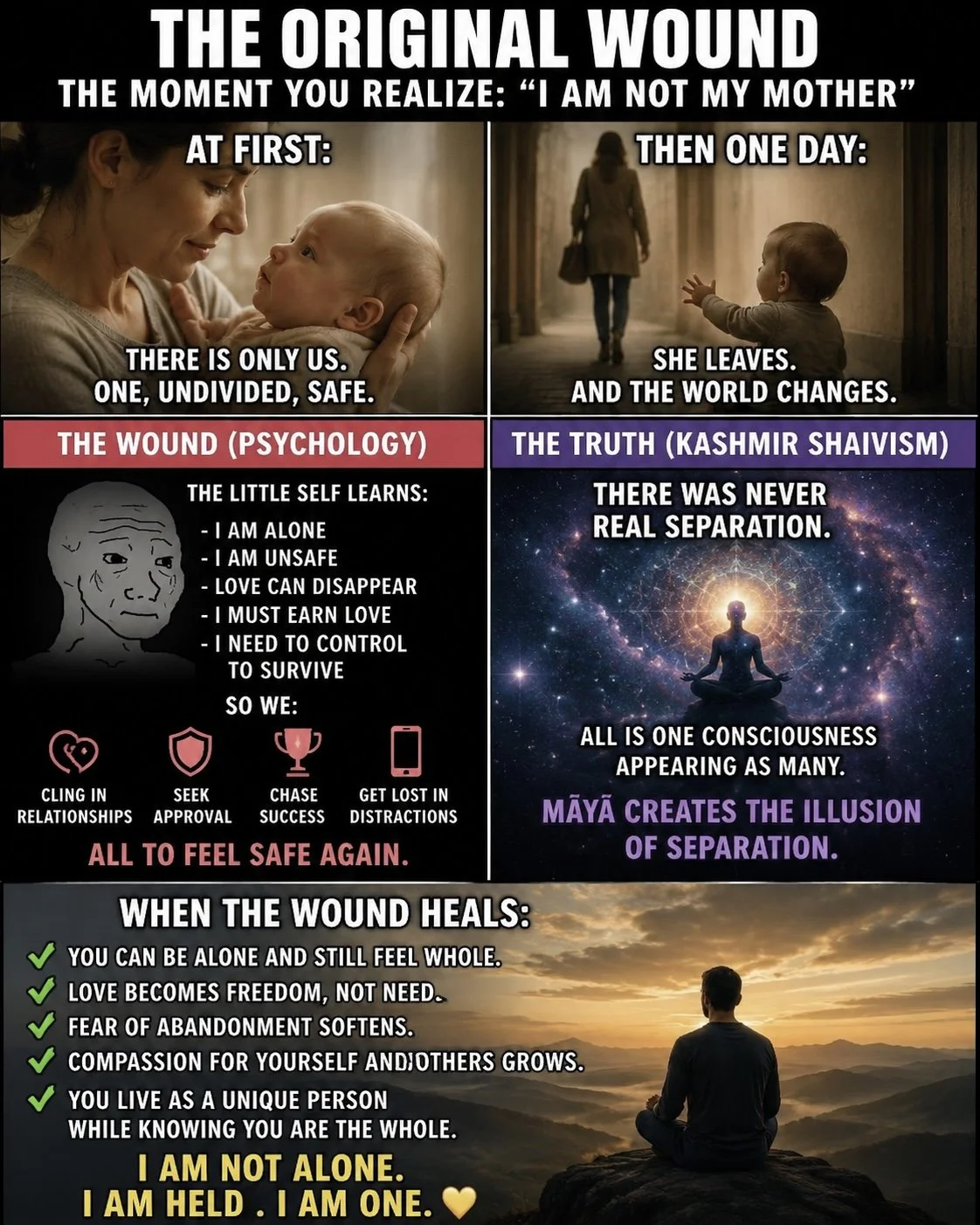
Separation from the mother: the primal human psychological wound and its impacts
As I crawl deeper into the different rabbit holes of my own psyche, it finally dawned on me that they all lead to one deep undergound chamber: the separation from the mother. This seems to be the first and most traumatic human experience.
I believe that this is the embodied mirroring of the separation of the soul from unitary consciousness. Both are by design to ensure concealment of one’s true nature.
This is an especially traumatic occurence as none of us have the physical, mental, and emotional regulation as infants to process and come to terms with this shattering experience. And the effects of this separation linger on and affect every aspect of our lives. I remember listening to Ram Dass talking about the same experience.
SYMBIOSIS
In the earliest months of life, a baby does not experience itself as an isolated individual. There is no clear distinction between “me” and “not me.” Hunger arises and is met with milk. Distress appears and is met with soothing. Warmth, touch, smell, and heartbeat all arrive from the same nurturing presence. To the infant, mother and self are part of one continuous field of experience.
This early state resembles what psychologists call symbiosis and what mystics might call primordial unity. The baby does not yet possess an ego in the mature sense. There is only undivided being and immediate experience.
But as the nervous system develops, the child begins to perceive that the mother can leave, that her body is distinct, and that comfort is not always instantly available. This realization is essential for healthy development, yet it can also be deeply distressing.
SEPARATION
For the infant, separation does not feel like a philosophical concept. It feels like danger.
Human babies are among the most dependent creatures in nature. Without the constant presence of a caregiver, they cannot survive.
As a result, the infant nervous system interprets disconnection as a potential threat to life itself. The child’s unspoken experience may be summarized as: “I am alone,” “I am unsafe,” or even “I may cease to exist.”
This is the primal embodied traumatic wound: the loss of the original felt unity and the birth of separateness.
THE ROLE OF ATTACHMENT
Psychologist John Bowlby, the founder of attachment theory, demonstrated that infants are biologically wired to seek closeness with caregivers because attachment is directly linked to survival (Bowlby, 1969). Mary Ainsworth later showed that the quality of this early bond shapes the child’s emotional regulation and patterns of relating to others throughout life (Ainsworth et al., 1978).
Modern reviews confirm that secure attachment predicts better resilience, healthier relationships, and improved stress regulation across the lifespan (Cassidy et al., 2013).
If the caregiver is consistently responsive and emotionally available, the child gradually learns that separation does not mean abandonment. The child internalizes a sense of trust and stability. Even when the mother is absent, the child feels that connection still exists. The body learns: “I can be separate and still be safe.”
If, however, the caregiver is inconsistent, rejecting, overwhelmed, or frightening, the child may internalize a very different message. Separation becomes associated with fear and insecurity. The child may unconsciously conclude: “Love can disappear,” “I must cling to others to survive,” or “I can trust no one but myself.”
ATTACHMENT EXPERIENCE BECOMES EGOIC BELIEFS AND NERVOUS SYSTEM PATTERNS
These early conclusions become embedded not only as beliefs but as patterns in the nervous system. They shape heart rate, hormonal responses, muscle tension, and the habitual ways a person seeks connection and protection.
The ego emerges as a sophisticated survival strategy built around this original wound. What we call personality is often a collection of adaptive responses to the fear of separation.
One child learns to please others to maintain connection. Another becomes highly independent to avoid vulnerability. Another seeks achievement, status, or perfection to become indispensable and therefore less likely to be abandoned. Others may withdraw emotionally, numb themselves through addiction, or attempt to control their environment.
In each case, the underlying question remains the same: “How do I remain connected and safe?”
Neuroscience confirms that early attachment experiences shape the developing brain. Allan Schore’s research demonstrates that the right hemisphere, which is crucial for emotional regulation and interpersonal attunement, develops in direct interaction with the caregiver’s nervous system (Schore, 2001). Responsive caregiving literally helps build the neural circuits needed for self-soothing and resilience.
The Adverse Childhood Experiences (ACE) study found that early relational stress is associated with increased risk of depression, addiction, heart disease, and many other health problems later in life (Felitti et al., 1998). What happens in the earliest relationships leaves lasting marks on both body and mind.
CONTRAST WITH SPIRITUAL TEACHINGSS
This psychological understanding stands in striking contrast some of the teachings of Kashmir Śaivism.
Kashmir Śaivism is a non-dual spiritual tradition that teaches that all existence is the expression of one universal Consciousness, known as Śiva. According to this view, the apparent division between self and other is a manifestation of māyā, or illusion. In this tradition, māyā does not mean that the world is unreal in the sense of non-existent. Rather, it refers to the power by which the one infinite Consciousness appears as many separate beings.
The child’s realization “I am separate from my mother” is developmentally true at the level of ordinary human experience. Yet from the standpoint of Kashmir Śaivism, it is only a relative truth. At the deepest level, neither mother nor child has ever been separate. Both arise within the same indivisible field of awareness.
Abhinavagupta and other masters of Kashmir Shaivism taught that bondage arises when consciousness forgets its own infinite nature and identifies exclusively with the limited individual self. Liberation, or recognition, occurs when one remembers that one is not merely a separate ego, but the universal Consciousness itself.
In this sense, the primal psychological wound mirrors the metaphysical illusion of māyā. The infant experiences the loss of unity and spends much of life trying to restore it. Spiritual awakening reveals that the unity sought was never truly lost.
THIS EARLY WOUND EXERTS AN ENORMOUS INFLUENCE OF SOCIAL AND PERSONAL BEHAVIOUR
In romantic relationships, adults often unconsciously seek in their partners the unconditional security they once depended upon from their mothers. Partners may be expected to soothe every fear, anticipate every need, and never withdraw emotionally. When they inevitably fail to do so, old attachment wounds are activated, leading to jealousy, anxiety, clinginess, or emotional shutdown.
In social life, the need for acceptance and belonging reflects the same underlying drive to avoid the pain of exclusion. Naomi Eisenberger and Matthew Lieberman used functional MRI to show that social rejection activates the dorsal anterior cingulate cortex and anterior insula, brain regions also involved in physical pain (Eisenberger et al., 2003). In other words, the brain processes social exclusion as a real threat.
This finding helps explain why criticism, rejection, and loneliness can feel so devastating. The body reacts as if something essential to survival is at stake.
The same wound can fuel ambition and achievement. Many people pursue wealth, status, and recognition not simply for practical reasons, but because they hope these accomplishments will make them worthy of love and immune to abandonment. If they become important enough, admired enough, or successful enough, perhaps they will finally feel secure.
Others turn to addiction, compulsive behavior, or spiritual seeking. Substance use may numb the pain of disconnection. Spiritual practice may become a genuine path to truth, or it may become another attempt to escape unresolved emotional wounds.
Yet this wound is not permanent.
HEALING THE PRIMAL WOUND
Healing begins when a person has repeated experiences of safe connection, emotional attunement, and internal regulation. Through therapy, secure relationships, meditation, and contemplative practice, the nervous system gradually learns that separation does not equal annihilation. Psychologists refer to this as earned secure attachment. Adults who had difficult childhoods can nonetheless develop stable and trusting relational patterns when they experience consistent emotional safety and insight (Roisman et al., 2002).
As healing deepens, the fear of abandonment begins to soften. Solitude becomes less threatening. Relationships become freer and less dependent. Love is no longer driven by desperation or the need to fill an inner void.
The body itself changes. Stress responses become less intense. The heart rate steadies. Muscles relax. Sleep improves. The mind becomes less preoccupied with securing approval and more available for presence.
At the spiritual level, contemplative traditions such as Kashmir Shaivism suggest that healing can culminate in direct recognition of one’s essential nature. The individual realizes that while the personal self remains functionally distinct, its deepest identity is not separate from the totality of existence.
This is not a regression to infantile fusion. It is a mature and conscious realization of non-separation.
The infant begins in unconscious unity, enters the painful experience of separation, and eventually may rediscover unity consciously.
When this primal wound is fully healed, life changes profoundly. Relationships are no longer based on fear of loss. Love becomes generous rather than possessive. Solitude becomes restful rather than frightening. Compassion naturally increases, because one recognizes that every person carries some version of the same wound.
Most importantly, the search for completion outside oneself begins to dissolve. The person no longer seeks another human being, achievement, or spiritual experience to restore what was lost.
Instead, one discovers that nothing essential was ever missing.
Psychology tells us that healthy development requires becoming a separate self. Kashmir Shaivism tells us that this separate self is a temporary appearance within a deeper, indivisible reality. Both perspectives are true.
The child must become an individual.
The adult may awaken to the realization that individuality and unity are not opposites.
The original wound whispers, “I am alone.”
Healing replies, “I am safe.”
Wisdom reveals, “I have never been separate.”