Inner marriage
I believe that the inner marriage within the individual of their own feminine and masculine energies and qualities is probably the most important requirement for a true deep sacred long-term divine partnership. My inner marriage started consciously in early 2026 and is resulting in wholeness within myself that I could not have imagined before. This is the culmination of decades of disciplined inner practice. The flip side of more wholeness is less inner polarity, division, and emotional and mental conflicts. It is truly wonderful to embody this transformation and inspire others.
The rest of this blog is exactly the same as the Bridal Chamber blog in the Spiritual Blog section as the spiritual and relationship lessons from the gnostic Bridal Chamber teachings are essentially the same.
The Gospel of Philip (Nag Hammadi Codex II, tractate 3) presents one of the most sophisticated symbolic teachings in early Christian literature through its notion of the “bridal chamber”, which we might call the “inner marriage.” Far from referring to a literal marriage or ritual space, the bridal chamber functions as a central metaphysical concept—a description of the restoration of unity within the human being and the culmination of spiritual transformation. Within this text, it is inseparable from themes of overcoming division, removing ignorance, and realizing resurrection as a present state. The text is explicit that this is not about ordinary sexuality - the “bridal chamber” requires inner integrity, not physical pairing. Said simply, the “bridal chamber” is the moment where you are no longer divided within yourself.
I. The Bridal Chamber as the Highest Mystery. The text situates the bridal chamber among a sequence of sacred acts:
“The Lord did everything in a mystery: a baptism and a chrism and a eucharist and a redemption and a bridal chamber.” (67.27–30)
This list is not random; it reflects a progressive movement. Baptism, anointing (chrism), and eucharist correspond to stages of initiation and participation. Yet the bridal chamber appears last, indicating not simply another rite, but the culmination of the process—the point at which transformation is completed. Thus, the bridal chamber is not merely symbolic ornamentation. It represents the final integration toward which all prior stages are oriented.
II. Not a Physical or Social Union. The text is careful to distinguish this concept from ordinary human relationships:
“The bridal chamber is not for the animals, nor for the slaves, nor for defiled women, but for free men and virgins.” (69.1–4)
These categories are not to be read literally or socially. Rather, they describe states of being: “animals” signify those governed purely by instinct; “Slaves” represent those bound by ignorance or external conditioning; “free” and “virgins” indicate those who are undivided and inwardly whole. The bridal chamber, therefore, requires a condition of inner coherence. It is not about external pairing, but about the integration of the self.
III. Separation as the Origin of Death At the heart of the text lies a mythic formulation of the human condition:
“If the woman had not separated from the man, she would not have died with the man. His separation became the beginning of death. Because of this, Christ came to repair the separation.” (70.9–14)
Here, “man” and “woman” function symbolically. Their separation represents the fragmentation of being—the division of what was originally unified. Death, in this framework, is not merely biological; it is the state of division itself. The role of Christ, accordingly, is not framed primarily as substitutionary sacrifice, but as restoration—the reuniting of what has been split. The bridal chamber is the space (or state) in which this reunion within occurs.
IV. Union and the End of Division. The outcome of entering the bridal chamber is expressed with striking clarity:
“Those who are united in the bridal chamber will no longer be separated.” (82.1–2)
This statement defines the bridal chamber as a decisive transformation. The condition of division—inner conflict, misidentification, fragmentation—is brought to an end. What was previously split becomes integrated into a single, coherent reality. In this sense, the bridal chamber is not a temporary experience but a permanent shift in being.
V. Transformation into Light. The Gospel frequently describes this transformation in terms of light:
“Those who have put on the perfect light… the powers do not see them, and they cannot be detained.” (77.25–30)
To “put on light” is to exchange one mode of existence for another. Earlier in the text, human beings are implicitly associated with coverings that conceal or distort. Here, that covering is replaced by a luminous state that is no longer subject to constraint.
The bridal chamber, then, is not only about union but about ontological transformation—a shift from a divided, obscured condition to one that is unified and transparent. One becomes invisible to lower forces and is no longer bound.
VI. Knowing as Becoming. This transformation is further clarified through the text’s understanding of knowledge:
“You saw the Spirit, you became spirit. You saw Christ, you became Christ. You saw the Father, you will become the Father.” (61.29–34)
Knowledge, in this context, is not observational but participatory. To truly perceive something is to become aligned with it. The bridal chamber thus involves a fusion of knower and known, eliminating the separation that characterizes ordinary perception.
This again reinforces the idea that the bridal chamber is not relational in a conventional sense. It is not the joining of two separate entities, but the realization that separation itself has been overcome. The union is not relational but identity-level. It is not joining something but becoming it.
VII. The Bridal Chamber and Resurrection. The text’s teaching on resurrection brings the meaning of the bridal chamber into full focus:
“Those who say that they will die first and then rise are mistaken. If they do not first receive the resurrection while they live, when they die they will receive nothing.” (73.1–5)
Resurrection is not postponed to the future; it is a present necessity.
“If one does not receive the resurrection while one is alive, one will receive nothing when one dies.” (73.1–3)
It must be realized during life as a transformation of being.
Within this framework, the bridal chamber can be understood as the process through which resurrection is attained. By restoring unity and removing division, it brings about the condition that the text calls “life.”
Thus, separation → death; union (bridal chamber) → resurrection.
VIII. Conclusion
The bridal chamber in the Gospel of Philip is a richly layered symbol that integrates multiple dimensions of the text’s thought. It represents:
The culmination of spiritual transformation.
The restoration of unity where division once existed.
The removal of the coverings that obscure true identity.
The realization of resurrection as a present state.
Stripped of its symbolic language, the concept points to a simple but profound idea: the human condition is one of division, and liberation consists in becoming undivided.
The bridal chamber is the name the text gives to that moment—or state—where this division ends.
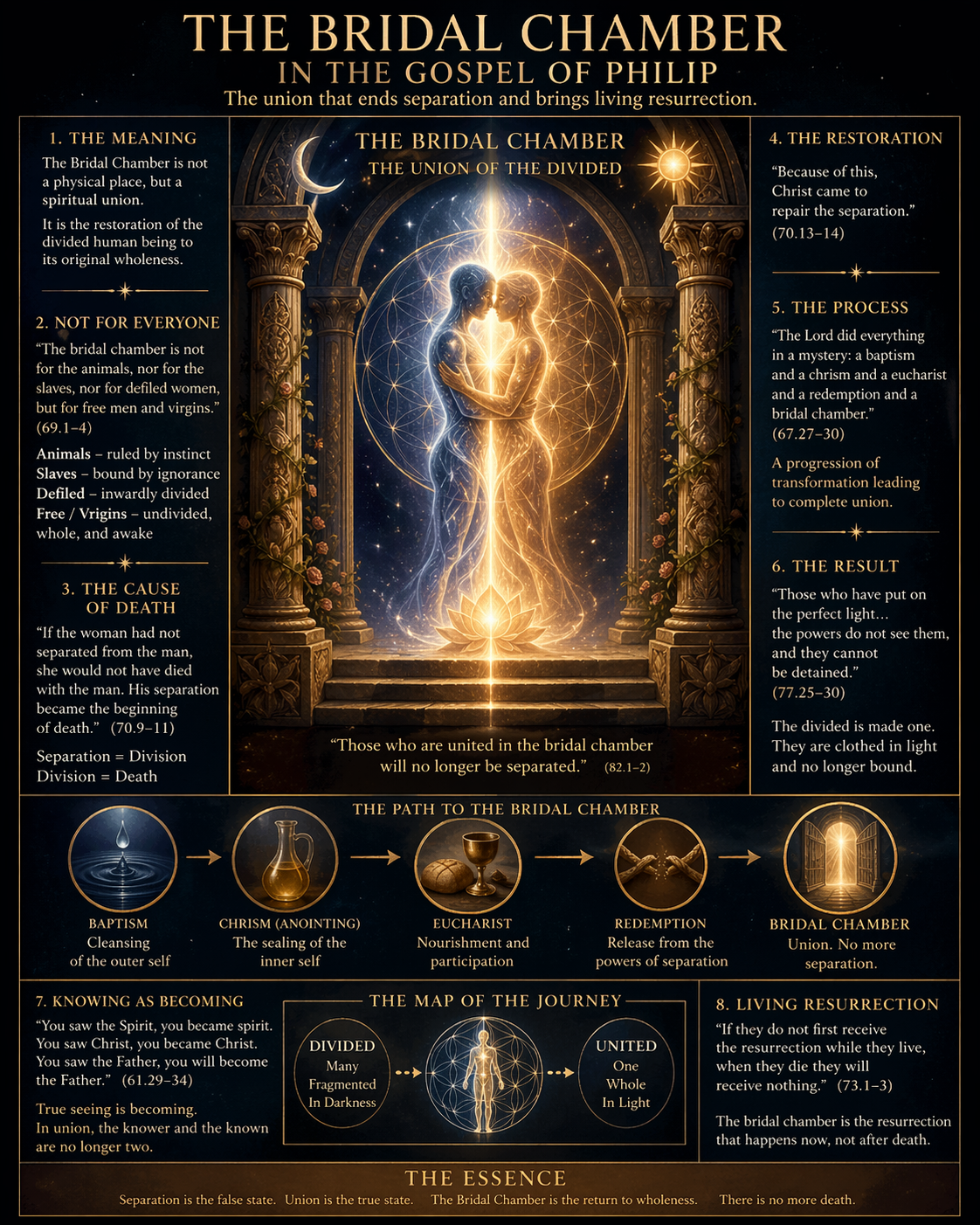
AI generated image
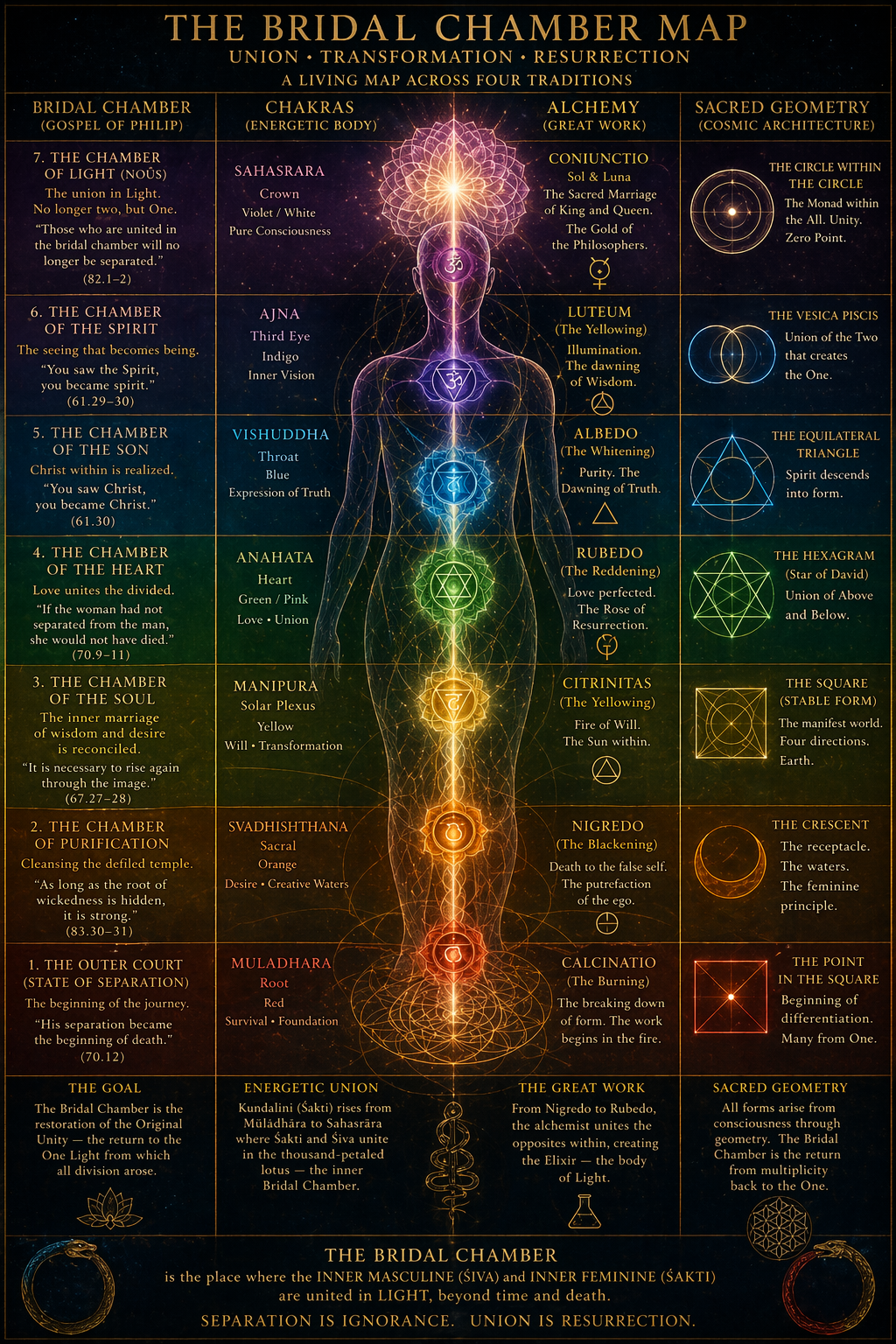
AI generated image