
The human experience - understanding and transforming with coherence
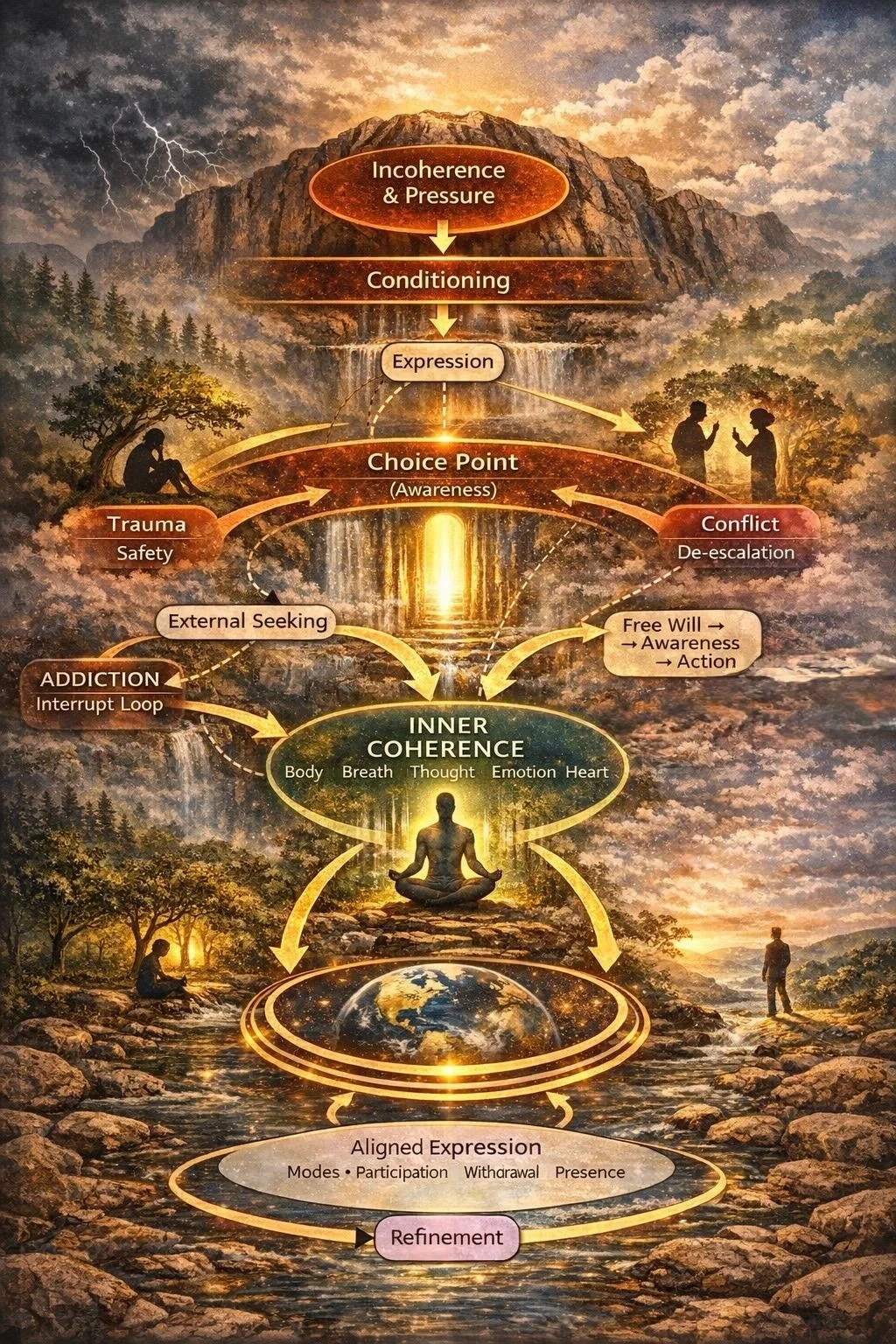
This is a practical and evolving recursive, coherence-based map of human experience, alignment, and expansion. Grounded in observation and lived application, it remains open to revision where experience contradicts or deepens it. This is not a critique of humanity, a philosophical stance, a metaphysical teaching, or a personal belief system. This map invites examination of the nature of free will and supports its coherent expression through alignment across all dimensions of human experience.
The human baseline → recurrent incoherence and buildup of pressure
Humans are complex multidimensional beings, consisting of physicality (body), cognition (thoughts), emotions, and actions. These aspects have one obvious quality across each individual: a wide range of expression. Maybe this explains why collectively, human systems tend toward recurring incoherence. This reflects individual misalignment between body, thought, emotion, and action, and results in high levels of mental health issues, emotional dysregulation, addictions, trauma, and conflict.
Incoherence is not just misalignment, but also compensatory and adaptive behavior. This behavior generates accumulated internal tension or pressure across physical, emotional, and mental layers, both individually and collectively. This pressure eventually releases, often in ways that reinforce and create further imbalances and suffering.
Primary causeof incoherence → unexamined free will, which results in limited knowledge (filter on understanding) and limited actions (conditioning)
Free will is the capacity to choose and express. Knowledge — awareness and understanding — shapes how that choice is directed. Action is the result. When awareness is limited, free will tends to express through conditioning rather than clarity. This conditioning filters perceptions and narrows available responses, often obscuring patterns of both self and environment that can be coherent.
Therefore, human free will can express itself in a wide spectrum, ranging from coherence to incoherence, and awareness to conditioning. Within incoherence and conditioning, the spectrum can range from seeking fleeting pleasure to avoiding pain at all costs, and from flight to fight. In practical terms, this manifests as a nervous system that is on frequently and has difficulty relaxing without outside factors. The repercussions of this include disconnection from the body (diminished body awareness), and tendency to get caught up in unhealthy mental and emotional patterns.
Expression of pressure → incoherent systems and relationships
Pressure releases and unexamined conditioning expresses outward as recurring patterns — conflict, division, fear, greed, and reactive behavior, among others — across both personal relationships and collective systems. Relationships often mirror unresolved systemic collective patterns rather than resolve them. Prolonged incoherence or overwhelming conditions within the individual can result in trauma and addiction, conditions which can take many years to resolve.
Coping mechanism → recurrent external seeking, reinforcing the conditioning
Attempts to solve recurrent incoherence through external seeking — whether for validation, happiness, or love — often reinforce the same underlying patterns rather than resolve them. It is trying to solve a problem from the same place it was created.
Solution → inner coherence
At any point, awareness of the underlying issues and a desire for a better outcome or experience of life, introduces the possibility for interrupting conditioned expression. This is possible through inner coherence. Inner coherence is progressively stabilizing, self-regulated inner alignment which reduces internal pressure, reveals conditioning more clearly, and enables the reduction of conditioning and ultimately more conscious expression of free will.
Mechanism forinner coherence → conscious choice for alignment anchored in repose
Inner coherence develops through conscious, moment-to-moment alignment of body, breath, thoughts, emotions, and heart qualities such as compassion — anchored in a state of stillness (repose) rather than force. Alignment is not constructed, but practiced and allowed, becoming more visible as internal resistance and fragmentation decrease through this mechanism.
There are preliminary steps in certain conditions → trauma, addictions, and conflict
This map always requires an accessible leverage point appropriate to its current state. It is based on the premise that the initial leverage is awareness of the baseline and desire for change and transformation, however, it breaks at least initially in the case of trauma, addictions, and conflict.
In trauma, the first leverage is safety; in addiction, interrupting the loop; and in conflict, de-escalation of the interaction field. After these are resolved, awareness through coherence as a subsequent leverage point becomes possible.
Trauma says: “coherence is unsafe.” The nervous system often cannot access awareness as the first choice point. Awareness may come after the reaction, not before. Here, the human system may not tolerate stillness, breath awareness may increase anxiety, and alignment may feel unsafe. So, coherence is not achieved by choosing it. It must be reintroduced gradually through safety in the body and nervous system regulation.
Addiction says: “coherence is not accessible — this thing/behavior is the fastest substitute.” Also, addiction introduces self-judgment loops that must be explicitly addressed. Under addiction, the leverage initially is interrupting the loop (on our own and/or with the help of people who care about us) and increasing capacity for change before the trigger escalates. Not willpower. Not insight, but timing and structure. This is done through delaying behavior (even slightly), changing the environment, and adding friction to the addictive pathway.
In conflict, de-escalation of the interaction field means accepting not winning, not being right, and not even being understood at least initially. Just reducing the activation.
Processes for cultivating and deepening inner coherence→ embodied practices
Practices that can effectively support coherence and nervous system regulation include the full human system — body, breath, thought, emotion, and heart — and their interactions.
It can be readily observed that slow rhythmic breathing and/or presence of awareness in the body slows down the fluctuations of thoughts and emotions, often allowing compassion to emerge.
One can start with practices that are natural and readily available. On average, humans breathe approximately 21,600 times a day, therefore, breath practices are natural and readily available.
Examples of such practices include:
— Awareness of body and breath during daily activity
— Structured breathing practices (e.g., harmonic breathing)
More advanced practices include conscious integration of shadows and reactive patterns.
In the case of trauma and addictions, simpler practices must be used first, such as movement, breath (only if tolerable), contact with another human, and sensory grounding.
In all cases, spending frequent and meaningful time in and observing the inherent coherence of nature, can be both grounding to the nervous system and a catalyst for inner alignment.
No practices guarantee coherence — they create the conditions. And, it is the lived integration that stabilizes coherence over time.
Inner-outer alignment → external expression matching inner coherence
As inner coherence stabilizes, it begins to reflect outward through behavior and communication:
Body → aligned action, care, movement
Breath → calm, grounded presence
Thought → clarity, reduced judgment
Emotion → regulation, openness
Heart → connection, compassion
Over time, this creates increasing consistency between inner state and outer expression.
Feedback loop → outer expressions refine or confirm the inner coherence
External outcomes act as feedback, reflecting the current level of inner coherence. This requires the capacity for honest observation of cause-and-effect, self-reflection, and self-correction. Reactions such as judgment, projection, or division may indicate unresolved patterns or incomplete integration. It is important to realize that often there is a delay between inner shifts and consistent outer expression.
Result → increasing coherence and sense of openness
Increasing coherence can be experienced in two ways:
Practically: reduced reactivity, greater clarity, and more stable alignment.
Experientially: a sense of openness, ease, and reduced identification with rigid patterns.
These experiences may be interpreted in different ways, but they consistently reflect a less contracted mode of being.
Modes of engagement with the world → participation / withdrawal / presence
Coherence does not require a fixed stance towards the world and can be expressed in different modes, which are fluid and can shift moment to moment.
Participation: active engagement and influence. Nothing might change in one’s circumstances and engagements due to coherence but their experience is less contracted.
Withdrawal: intentional autonomy and restoration. One might feel out of sync with mundane life as one functions from increased coherence and therefore sometimes being a hermit for a time can feel the right thing to do or to more fully integrate coherence within.
Presence: non-interference without disengagement. This is a neutral position between withdrawal and participation. One quietly goes about their life as a sovereign being in simple presence, neither withdrawing or actively participating.
The bottom line → embodying coherent use of free will is key
The deeper capacity underlying coherence is the freedom to choose. Coherence, love, and similar qualities can be seen as expressions of this freedom rather than its source.
The ability to choose alignment, clarity, or care is more fundamental than any particular state. It is also the inner impulse fueling the desire for transformation beyond the baseline human experience.
AI generated image