
The Garment of Forgetting and the Living Resurrection in the Gospel of Philip
The Gospel of Philip is part of the Nag Hammadi library, a collection of early Christian and Gnostic texts discovered in Egypt in 1945. It was written in Coptic (translated from earlier Greek), probably in the 3rd century AD. It represents a more mystical, symbolic, and inner-transformation view of Christianity.
The Gospel of Philip is one of the apocryphal texts (“hidden” writings) which didn’t make it in the Bible because it was written well after the time of the apostles; is a collection of mystical sayings and interpretations; and its ideas differ significantly. It presents views that clash with mainstream Christianity, especially resurrection as a present inner awakening, not a future bodily event; heavy use of symbolism (bridal chamber, light, garments, union); and a more gnostic worldview (knowledge/gnosis as salvation).
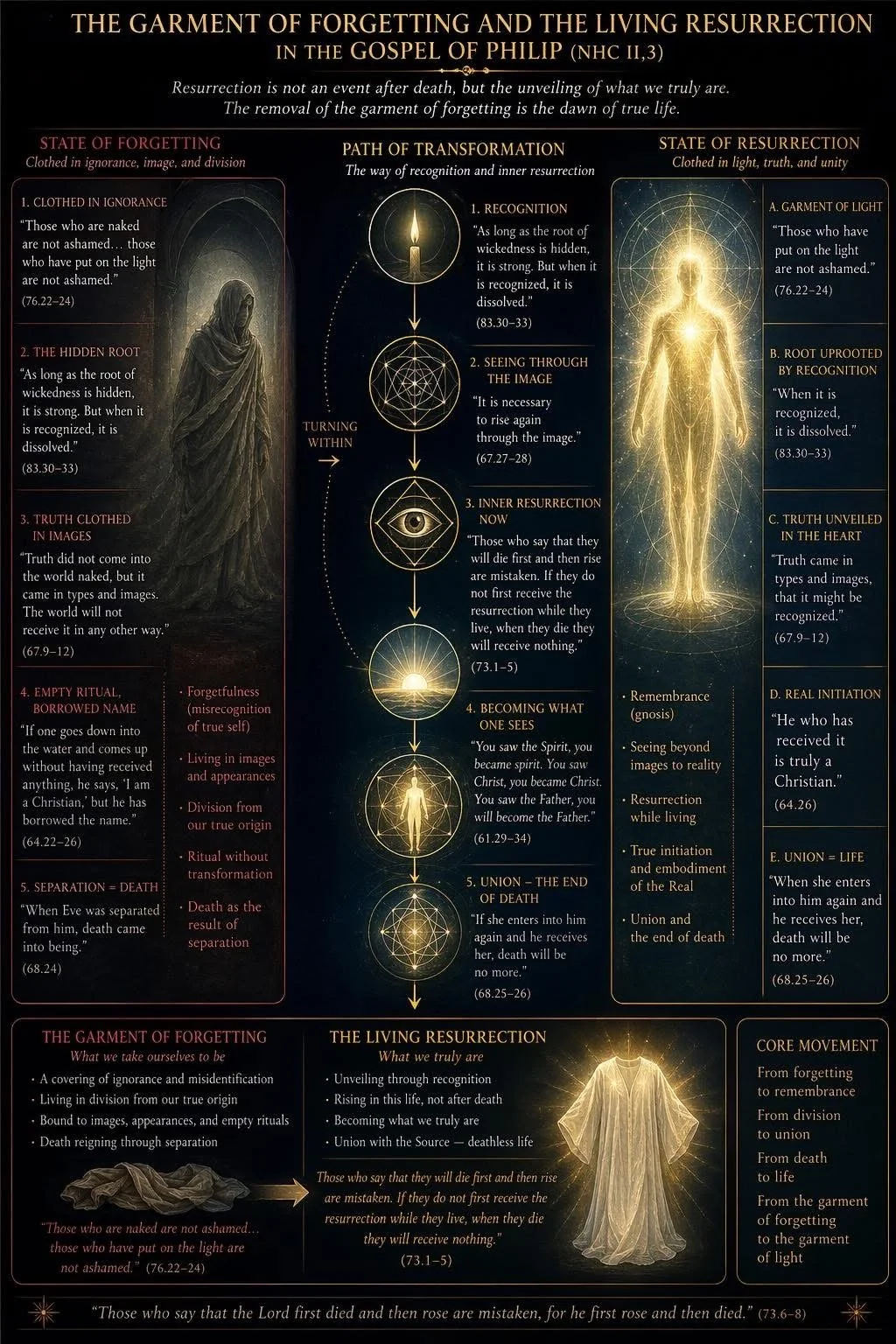
This Gospel presents a radically non-literal understanding of both embodiment and resurrection. While the idea of “garment of forgetting” does not appear verbatim in this text, the concept is unmistakably present through its recurring symbolism of garments, nakedness, light, and transformation. In parallel, the text offers one of the clearest early Christian statements that resurrection is not a future event, but a present realization. The Gospel helps the seeker understand the teachings of the garment, move into recognition, rise into resurrection, and melt in unity.
I. The Garment: Clothing, Ignorance, and the Loss of Form. The text consistently frames human existence as a condition of being clothed in something that conceals true identity.
“Those who are naked are not ashamed… those who have put on the light are not ashamed.” (Gospel of Philip 76.22–24)
Here, two contrasting “garments” are implied: nakedness or light is the original, unhidden being, and other clothing (unstated but implied) is concealment and distortion.
This aligns with a broader Gnostic motif: the human being has taken on a covering that obscures origin and essence. A related passage suggests that what is hidden—unseen within—maintains its power precisely because it remains unrecognized:
“As long as the root of wickedness is hidden, it is strong. But when it is recognized, it is dissolved.” (83.30–33)
This “hidden root” functions like a garment of ignorance—not merely moral error, but a state of unconsciousness or forgetfulness. The covering is not just physical; it is epistemological. The text also emphasizes that truth itself is veiled:
“Truth did not come into the world naked, but it came in types and images. The world will not receive it in any other way.” (67.9–12)
Thus, both the human being and truth itself appear clothed. Reality is mediated through coverings—images, forms, and symbols—which must be penetrated or “seen through.” This reinforces the idea that the human condition involves misrecognition through layered appearance, analogous to wearing a garment that is mistaken for the self.
II. Forgetfulness as Misidentification. Although the word “forgetting” (λήθη) is not foregrounded as in other Gnostic texts, the Gospel of Philip clearly describes a condition in which humans fail to recognize their true nature. This is expressed through its language of empty ritual versus inner realization:
“If one goes down into the water and comes up without having received anything, he says, ‘I am a Christian,’ but he has borrowed the name.” (64.22–26)
Here, the “garment” takes the form of identity without substance—a borrowed label without transformation. One remains clothed in illusion, despite outward change. Similarly, the text distinguishes between appearance and essence through the concept of the “image”:
“It is necessary to rise again through the image.” (67.27–28)
The “image” here is not superficial appearance but a restored form, implying that the current condition is one of distortion or misalignment. The human being, as presently constituted, is not in its original state but in a covered or altered one—a condition consistent with the idea of a “garment of forgetting.”
III. Resurrection as Present Transformation. The Gospel of Philip is unambiguous: resurrection is not an event after death, but a state that must be realized during life.
“Those who say that they will die first and then rise are mistaken. If they do not first receive the resurrection while they live, when they die they will receive nothing.” (73.1–5)
This is one of the strongest statements in early Christian literature rejecting a purely future resurrection. Resurrection is not deferred—it is required now. An even more striking formulation reverses the conventional sequence:
“Those who say that the Lord first died and then rose are mistaken, for he first rose and then died.” (73.6–8)
Here, “resurrection” refers to a prior awakening, a transformation of being or consciousness that precedes physical death. Death, in this framework, is secondary—almost incidental—compared to the primary act of coming into true life.
IV. The Removal of the Garment: Becoming What One Sees. The process of resurrection is described not as external salvation but as identity transformation:
“You saw the Spirit, you became spirit. You saw Christ, you became Christ. You saw the Father, you will become the Father.” (61.29–34)
This passage articulates a principle of participatory knowing: to truly perceive is to become; to recognize is to remove separation. In this sense, the “garment of forgetting” is precisely what maintains the illusion of separation. Resurrection is the removal of that garment, resulting in direct identity with what is perceived.
V. From Division to Unity: The End of Death. The text also encodes this transformation symbolically through the myth of separation and reunion:
“When Eve was still in Adam, death did not exist. When she was separated from him, death came into being. If she enters into him again and he receives her, death will be no more.” (68.22–26)
Here separation is division, multiplicity, ignorance; union = restoration, wholeness, life. Death itself is presented as a function of division, not merely biological cessation. Thus, resurrection is the reversal of division, the reintegration of what has been split.
VI. Conclusion. The Gospel of Philip presents a coherent vision:
Human beings exist in a covered condition, symbolized by garments, images, and misidentification.
This condition corresponds to ignorance or forgetfulness, not in a trivial sense, but as a fundamental misperception of reality.
Resurrection is the removal of this covering, the recovery of true identity.
This process must occur during life, not after death.
In this framework, the “garment of forgetting” is not a single idea but a structural idea expressed through multiple metaphors. To “rise” is to see, recognize, and become—to exchange the garment of distortion for the garment of light.
AI generated image