
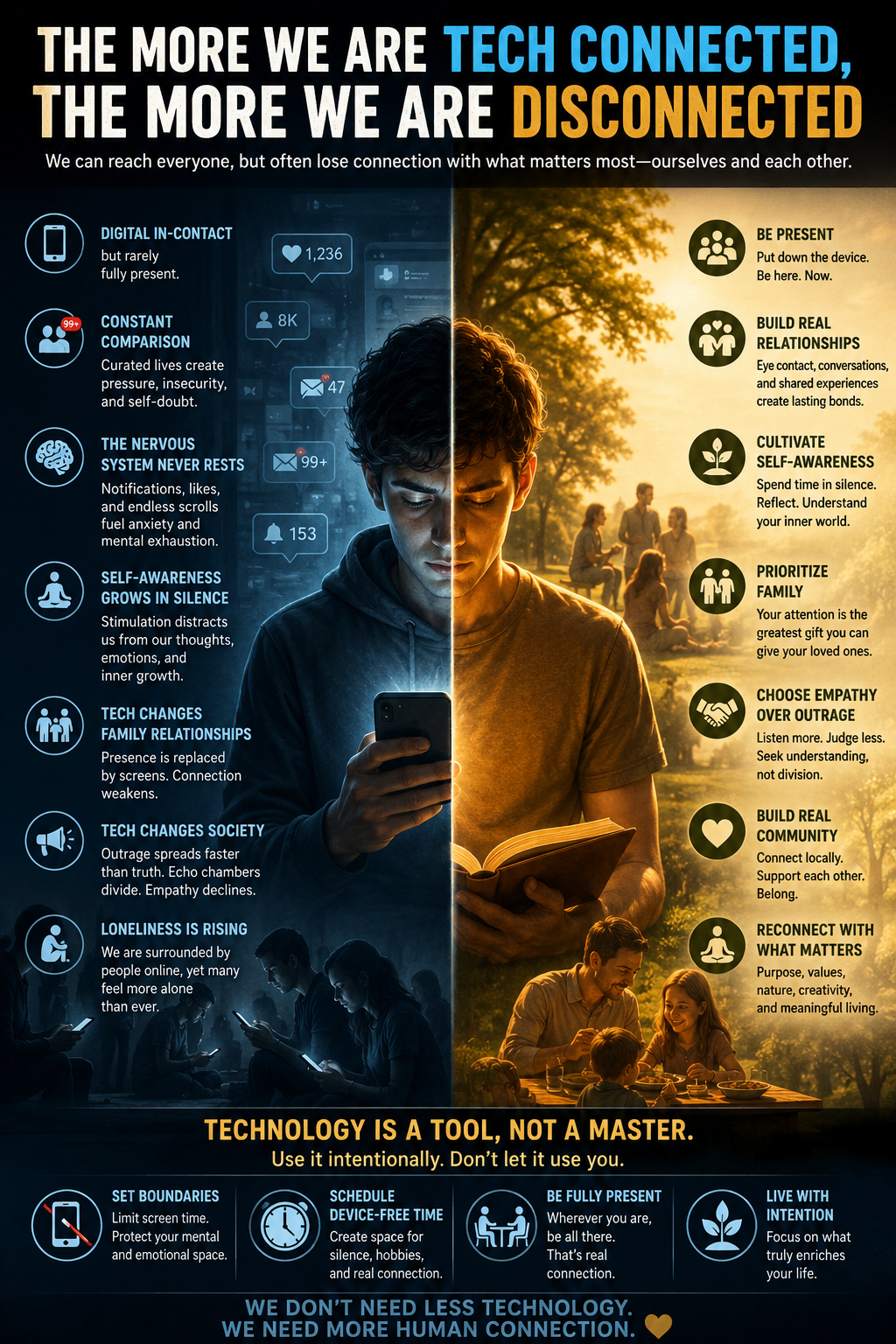
The more we are tech connected, the more we are disconnected
We live in the most technologically connected time in human history. A person can instantly message someone across the world, video chat with family, post thoughts to thousands of people, and carry the sum of human knowledge in their pocket.
Social media promises connection. Smartphones promise convenience. Algorithms promise personalization.
Yet beneath all of this connection, many people feel more lonely, anxious, emotionally exhausted, and disconnected than ever before. Modern technology has connected our devices while slowly disconnecting our inner world.
The strange paradox of our age is that we can reach almost everyone except ourselves.
WE EVOLVED AROUND REAL HUMAN PROXIMITY
Human beings evolved through direct physical presence. For most of history, connection meant eye contact, touch, tone of voice, shared silence, community rituals, and face-to-face interaction. The nervous system developed around real human proximity.
DIGITAL IN-CONTACT, BUT RARELY FULLY PRESENT
But today, much of our interaction happens through screens, fragmented attention, endless notifications, and algorithm-driven stimulation. We are constantly “in contact,” but rarely fully present.
Research increasingly shows this contradiction. A large study published in the American Journal of Preventive Medicine found that heavy social media users were significantly more likely to feel socially isolated compared to those who used it less [Primack et al., 2017]. Another study from the University of Pennsylvania found that reducing social media use led to measurable decreases in loneliness and depression [Hunt et al., 2018]. The more people scrolled through curated digital lives, the worse many of them felt about their own lives.
CONSTANT COMPARISON AND PERFORMANCE
This happens partly because social media does not merely connect people — it creates comparison. Human beings naturally compare themselves with others, but social media amplifies this to an extreme level. People no longer compare themselves with neighbors or friends alone; they compare themselves with thousands of carefully edited lives every single day. Online identities become performances rather than authentic expressions. People display success, beauty, happiness, spirituality, wealth, and relationships while hiding confusion, pain, insecurity, and emptiness.
As a result, many people feel pressured to become brands rather than human beings.
THE NERVOUS SYSTEM NEVER RESTS
Every notification creates anticipation. Every “like” becomes a tiny reward. Every scroll offers novelty.
Studies on dopamine and variable reward systems show that social media platforms activate the same reward pathways involved in gambling addiction [Alter, 2017; Montag et al., 2019]. The mind becomes conditioned to seek stimulation constantly. Silence begins to feel uncomfortable. Stillness feels threatening.
SELF-AWARENESS GROWS IN SILENCE
The tragedy is that self-awareness grows in silence, not in stimulation.
A person who cannot sit quietly without reaching for a device slowly loses contact with their own inner landscape.
Thoughts are interrupted before they deepen. Emotions are distracted before they are felt. Anxiety is numbed before it is understood. Instead of processing life internally, people outsource attention externally.
Many individuals today do not know what they actually feel unless an algorithm reflects it back to them.
TECH CHANGES FAMILY RELATIONSHIPS
Technology also changes family relationships in subtle but profound ways. Families may sit in the same room while mentally existing in completely different worlds. Parents scroll while children seek attention. Children grow up watching adults prioritize devices over presence. Meals become quieter. Conversations become shorter. Emotional intimacy weakens.
Research from developmental psychology shows that emotional attunement between parent and child is essential for healthy emotional development [Siegel, 2012]. Children need responsive facial expressions, eye contact, emotional mirroring, and uninterrupted attention to develop secure attachment and emotional regulation. But when parents are psychologically absorbed by devices, children often experience “partial presence.” The body of the parent is there, but the attention is elsewhere.
Over time, this creates subtle emotional wounds. The child may unconsciously feel: “Something else is more important than me.”
TECH CHANGES SOCIETY - EVERYONE SPEAKS, BUT FEW TRULY HEAR
At the societal level, the effects become even larger. Social media fragments society into tribes driven by outrage, fear, identity, and emotional reaction. Algorithms are not designed primarily to create wisdom or unity. They are designed to maximize engagement. And the strongest engagement often comes from anger, fear, conflict, controversy, and emotional stimulation.
Research from MIT found that false news spreads faster on social media than truthful information because emotionally charged content generates stronger reactions [Vosoughi et al., 2018]. Algorithms learn what provokes people emotionally and feed them more of it. Over time, individuals become trapped in psychological echo chambers where they mostly encounter views similar to their own
The result is increasing polarization and decreasing empathy.
People begin seeing each other not as human beings but as ideological enemies, political identities, or social categories. Nuance disappears. Listening disappears. Everyone speaks, but few truly hear.
Paradoxically, modern hyper-connectivity often weakens real community. In traditional communities, people depended on neighbors, family, and local relationships. Today, many individuals know intimate details about strangers online while barely knowing the people living next door.
Loneliness itself has become a public health issue. Former U.S. Surgeon General Vivek Murthy described loneliness as an epidemic affecting mental and physical health similarly to smoking or obesity. Chronic loneliness has been associated with increased anxiety, depression, inflammation, cardiovascular disease, and shortened lifespan [Holt-Lunstad et al., 2015].
We are digitally surrounded yet emotionally starving.
SPIRITUAL ATTENTION AND ENERGY BODY CRISIS
Spiritually, this crisis can also be understood as an attention crisis.
Ancient spiritual traditions consistently taught that attention is life force. Where attention goes, energy follows. In yogic traditions, attention is not merely mental focus; it is subtle energy movement. Whatever dominates awareness shapes consciousness itself.
Modern technology competes aggressively for human attention because attention has become one of the most valuable resources in the world.
Every notification pulls awareness outward. Every endless feed scatters concentration. Every algorithm attempts to capture and hold psychic energy. The result is fragmentation of consciousness. Instead of sustained presence, many people live in a constant state of divided attention.
From a cakra perspective, this fragmentation affects several energy centers deeply.
The root cakra, associated with grounding, stability, safety, and embodiment, weakens when people spend excessive time mentally disconnected from physical reality. Many individuals today feel chronically ungrounded, restless, anxious, and unable to simply be present in their bodies.
The sacral cakra, connected to emotional flow, intimacy, sensuality, and authentic feeling, becomes distorted when relationships are increasingly mediated through screens, performance, and superficial validation. Emotional depth is often replaced by curated identity and digital stimulation.
The solar plexus cakra, associated with personal power and self-worth, becomes heavily affected by comparison culture. People begin measuring their value through likes, followers, attractiveness, productivity, or social status. Self-worth becomes externally dependent rather than internally rooted.
The heart cakra may suffer the most. Real human connection requires vulnerability, presence, empathy, and emotional openness. But online interaction often creates emotional distance while simulating closeness. Many people have hundreds of online connections yet few relationships where they feel truly seen.
The throat cakra also becomes conflicted. Technology allows constant expression, yet authentic communication often decreases. People speak more publicly but reveal less truthfully. Communication becomes reactive rather than conscious.
The third eye cakra, associated with insight and clarity, becomes overstimulated by endless information. Humans were not designed to process infinite streams of news, opinions, videos, outrage, advertisements, and stimulation every day. Mental exhaustion replaces inner clarity.
Finally, the crown cakra — connected to transcendence, meaning, unity, and spiritual connection — weakens when consciousness becomes trapped in perpetual distraction. Deep spiritual awareness usually requires stillness, silence, contemplation, and sustained presence. But the modern digital environment conditions the mind toward the opposite: fragmentation, speed, and compulsive stimulation.
In many ways, technology constantly pulls awareness outward while spiritual traditions invite awareness inward.
This does not mean technology itself is evil. Technology is a tool. It can educate, heal, connect distant loved ones, spread wisdom, and create extraordinary possibilities. The problem arises when technology stops serving humanity and begins consuming human attention itself.
The deeper issue is unconscious use.
When people lose the ability to be alone without stimulation, something essential is lost. Solitude is where self-reflection happens. Silence is where deeper emotions surface. Presence is where intuition speaks. Without these spaces, individuals slowly become strangers to themselves.
Many people today know what is trending before they know what they truly feel.
HEALING
Healing this disconnection begins with reclaiming attention.
Simple acts become revolutionary: sitting in silence, walking without a phone, having uninterrupted conversations, eating without screens, spending time in nature, meditating, praying, journaling, breathing consciously, or simply being fully present with another human being.
Research on mindfulness and meditation consistently shows improvements in emotional regulation, attention, empathy, stress reduction, and overall well-being [Davidson et al., 2003; Goleman & Davidson, 2017]. Presence heals fragmentation.
Human beings do not only need information.
They need meaning.
They need embodiment.
They need intimacy.
They need silence.
They need real connection.
The modern world has mastered communication technology, but many people are starving for communion.
And perhaps the greatest challenge of our age is not learning how to connect more digitally, but remembering how to connect deeply — with ourselves, with each other, and with life itself.
AI generated image