Crystalline Body - Crystalline Earth, as Within - so Without
Since I was a young child who grew up in the mountains of Bulgaria, I have resonated highly with crystals. It is high time that I examine the science behind this connection.
The idea that the human body is “crystalline” is often used in a poetic or spiritual way, but there is also some real science behind it. The human body is not a crystal like quartz or amethyst—it is soft, full of water, and always changing. Still, there are real crystal structures inside us. These show that the same basic forces that shape Earth’s minerals are also at work in the human body. This can explain why some sensitive people like myself can experience a deep resonant connection to crystals, while others may appreciate their surface beauty.
The Earth is structured through fixed crystalline geometry and the majority of the body is structured as self-organizing geometry.
CLEAR CONNECTIONS
The clearest example is bone. Bone is not just solid—it is made of two parts working together. One part is collagen, a flexible protein. The other part is tiny crystals called hydroxyapatite, which are made of calcium and phosphate. These crystals are arranged in an ordered pattern, similar to mineral crystals. They give bone its strength. But unlike a rock, bone is alive. It is always breaking down and rebuilding itself depending on how we use our bodies, what we eat, and our environment. So, bone is like a living form of crystallization—guided not just by physics, but also by the body.
Teeth show a similar idea. The outer layer of teeth, the enamel, is one of the hardest materials in the body. It is made almost completely of hydroxyapatite crystals. These crystals are packed tightly together in long rods. This strong, ordered structure helps teeth handle a lot of pressure when we chew. Like bone, enamel shows how the body uses crystal structures for a purpose. No wonder hydroxyapatite toothpaste is becoming very popular.
Another especially interesting example is the inner ear. Inside the part of the ear that controls balance, there are tiny crystals made of calcium carbonate. These are called otoconia. They move when your head moves and help your body sense gravity and direction. This means that part of your ability to stay balanced depends on crystals responding to physical movement—similar to how minerals react to forces in nature.
BRAIN
The idea that the human brain contains crystals often appears in both scientific discussions and popular imagination. While it is true that crystalline structures can be found within the brain, their presence is subtle, limited, and very different from the structural role crystals play in other parts of the body such as bones or teeth. Understanding what these crystals are—and what they are not—helps clarify the relationship between biological tissue and mineral structure without exaggeration.
One of the most well-documented types of crystals in the brain is magnetite, an iron oxide mineral (Fe₃O₄). These crystals are extremely small, existing at the nanometer scale, and have been identified in various regions of the brain, including areas involved in memory and spatial processing such as the hippocampus. Some of these magnetite particles appear to be formed by biological processes, while others may originate from environmental exposure, such as airborne pollution. Their magnetic properties have led to speculation about whether they could play a role in sensing magnetic fields, similar to mechanisms observed in certain animals like birds. However, in humans, this function remains unproven. At present, the role of magnetite in the brain is not fully understood, and it may range from being biologically incidental to potentially influencing local chemical or electrical conditions.
In addition to magnetite, the brain can also contain calcium-based microcrystals, particularly in the pineal gland. These deposits, sometimes referred to as “brain sand” (corpora arenacea), are composed mainly of calcium phosphate or calcium carbonate. Unlike the carefully organized crystalline structures found in bone or enamel, these formations are generally irregular and increase with age. Their exact function is still uncertain. The pineal gland is known for its role in regulating circadian rhythms through the production of melatonin, but whether these crystals contribute directly to that function remains unclear. In most cases, such calcifications are considered a normal part of aging rather than a specialized or essential biological feature.
Despite the presence of these crystalline elements, it is crucial to recognize that the brain is not a crystalline organ. Its primary composition is soft, dynamic tissue—approximately 75 to 80 percent water—organized into networks of neurons and glial cells. Brain function arises from electrochemical signaling, not from rigid structural lattices. Information is processed through constantly changing patterns of electrical activity and chemical exchange, allowing for flexibility, learning, and adaptation. This fluid, responsive nature stands in contrast to the fixed, repeating order that defines true crystals.
The distinction becomes clearer when comparing the brain to other parts of the body. Bones and teeth rely on crystalline structures for mechanical strength; their hydroxyapatite crystals form organized lattices that provide rigidity and durability. In the brain, however, structure must remain flexible to support rapid signaling and continuous change. Any crystalline presence is therefore minimal and not central to its core function.
In conclusion, crystals do exist in the human brain, but only in small and specific forms such as magnetite nanoparticles and calcium-based deposits. Their roles are still being studied and, in many cases, remain uncertain. What is clear is that they do not define how the brain works. Rather than being a crystalline system, the brain is best understood as a highly dynamic, fluid network of information processing. The presence of crystals within it reflects the broader fact that the human body incorporates mineral elements in many ways, but always in service of life’s primary requirement: adaptability.
CONNECTIONS THROUGH ORDER
Beyond these clear examples, the body also shows a general pattern of organization. Proteins fold into very specific shapes. Cell membranes arrange themselves in stable layers. Structures inside cells form patterns that look like tiny frameworks. These are not crystals in the strict sense, but they still show how the body creates order. Life uses structure, but it stays flexible instead of becoming rigid.
To understand the connection between the human body and Earth crystals, it helps to look at what they share. Crystals like quartz or calcite form deep in the Earth through pressure, heat, and time. Their atoms settle into repeating patterns that are stable. In the human body, many of the same elements—like calcium, phosphorus, carbon, and oxygen—are used again. But instead of forming freely, they are controlled by cells. The body decides where crystals grow, how big they are, and what they do.
The main difference is how they behave. Earth crystals are mostly still and do not change much once they form. The human body is always changing. It builds, breaks down, and rebuilds its structures all the time. Crystals in nature keep their shape. The body adjusts its structure based on what it needs.
This shows a deeper connection. Both crystals and living things show how order can come from chaos. In the Earth, this order appears as clean, repeating crystal shapes. In the body, it appears as organized structures that can still move and adapt. The body does not try to be a perfect crystal. Instead, it uses some of the same ideas in a more flexible way.
From this point of view, the connection between the human body and Earth crystals is not just symbolic—it is based on real science. They follow the same physical laws. They use the same basic elements. The difference is in how those elements are organized and used.
You could think of it like this: the Earth forms crystals from raw materials; life takes those materials and builds something more complex.
The human body becomes a place where structure, energy, and function all come together.
So, saying the body is “crystalline” is partly true. There are real crystals inside us that help us move, stay strong, and sense the world. But the body is more than a crystal. It is a living system that uses crystal-like structures as tools, while staying flexible and always changing.
% CRYSTALIZATION OF EARTH AND BODY
The Earth’s crust is, for all practical purposes, almost entirely crystalline. The solid portion of the crust is made up of rocks, and rocks are composed of minerals. By definition, minerals are crystalline solids, meaning their atoms are arranged in highly ordered, repeating patterns known as crystal lattices. Common rocks such as granite, basalt, and metamorphic formations are all built from interlocking mineral crystals. In some cases, these crystals are large enough to be seen with the naked eye, while in others they are microscopic. However, regardless of size, the underlying structure remains crystalline. There are only minor exceptions, such as volcanic glass like obsidian or certain amorphous materials, which lack this ordered arrangement. These exceptions are relatively rare, making up only a very small fraction of the crust.
As a result, it is reasonable to say that approximately 95% to 99% of the Earth’s crust is crystalline in nature. This gives the planet’s outer layer a stable, rigid, and highly ordered structural framework.
In contrast, the human body is only partially crystalline and is dominated by fluid and dynamic components. The body is composed of approximately 60% water, which exists in a liquid state and does not form crystalline structures under normal conditions. The remaining portion consists of a complex mixture of organic molecules such as proteins, lipids, carbohydrates, and nucleic acids, along with various minerals. While many of these biological molecules have organized structures, they do not form true crystals in the same way minerals do. Instead, they are flexible, dynamic, and constantly interacting, allowing for the processes necessary for life
As we discussed, true crystallinity in the human body is primarily found in bones and teeth. These structures contain hydroxyapatite, a crystalline form of calcium phosphate, which provides strength and rigidity. This mineral component represents the most significant crystalline portion of the body. In addition, there are small amounts of microcrystalline materials in specific locations, such as the inner ear, where tiny crystals play a role in balance, and occasional calcifications in tissues. Even so, these crystalline components make up only a limited portion of the body’s overall mass.
If one considers only true mineral crystals, roughly 10 to 20 percent of the human body can be described as crystalline. If a broader definition is used—one that includes highly ordered biological structures such as proteins and DNA—then perhaps 20 to 30 percent of the body exhibits crystal-like organization.
However, the majority of the body remains fluid and dynamic, reflecting the fundamentally different requirements of living systems.
This contrast highlights a deeper principle. The Earth’s crust is structured for stability. Its crystalline nature provides a durable, long-lasting framework that changes only over long geological timescales.
The human body, on the other hand, is structured for function. It must move, adapt, exchange energy, and sustain complex biochemical processes. As a result, it combines a smaller crystalline component for support with a much larger fluid and flexible system for activity.
In simple terms, the Earth can be understood as a predominantly crystalline system, built from rigid, ordered mineral structures. The human body, by comparison, is a hybrid system—partly crystalline, but largely fluid and dynamic. This difference reflects the broader distinction between non-living and living matter: one prioritizes stability and structure, while the other depends on movement, interaction, and continuous change.
CARBON
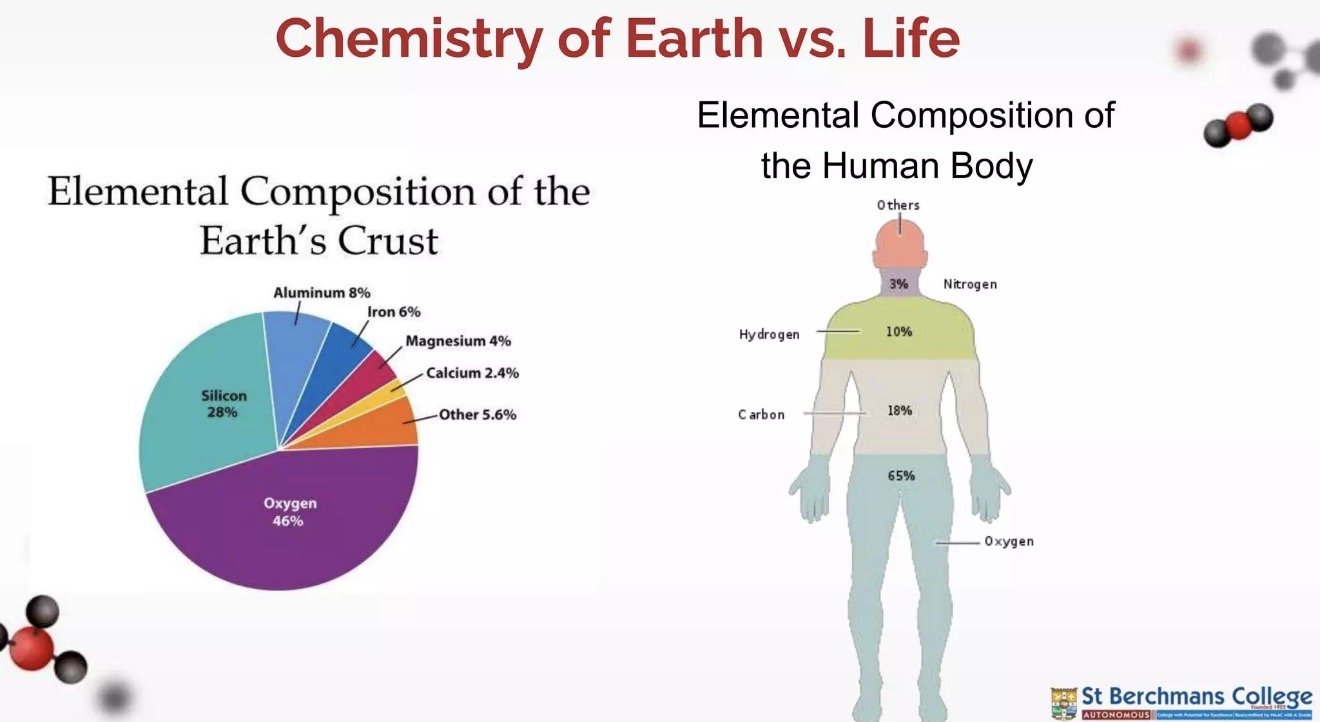
The comparison between the composition of the Earth’s crust and the human body reveals an important difference in how non-living and living systems are built. The simpler chart on the left represents the Earth’s crust while the one on the right represents the human body.
At first glance, it may seem surprising that carbon is not shown in the Earth’s crust chart. However, this is not an error. Carbon is simply not a major component of the crust, so its amount is too small to be included among the dominant elements.
The Earth’s crust is made primarily of minerals, which are solid, inorganic substances that form rocks. The two most abundant elements in the crust are oxygen, making up about 46%, and silicon, at around 28%. These two elements combine to form silicate minerals, such as quartz and feldspar, which make up most of the rocks found on Earth. These minerals are structured in stable, repeating patterns, giving the crust its solid and durable nature.
Carbon does exist in the Earth’s crust, but only in very small amounts. It is typically found in specific forms, such as carbonates like limestone (calcium carbonate, CaCO₃), or in fossil fuels like coal and oil. Even when all these sources are considered together, carbon accounts for less than about 0.1% of the Earth’s crust. Because this percentage is so small compared to elements like oxygen and silicon, it is often grouped into the “other” category or left out of simplified charts entirely.
In contrast, carbon plays a central role in the human body. Life on Earth is carbon-based, meaning that carbon is the backbone of the molecules that make up living organisms. In the human body, carbon makes up about 18% of total mass. It is a key component of proteins, DNA, fats, and carbohydrates—molecules that are essential for structure, energy, and function in living systems. Carbon’s importance comes from its unique ability to form stable bonds with many other elements, including itself. This allows it to create long chains and complex structures, which are necessary for the chemistry of life.
This leads to a deeper and more meaningful contrast. The Earth’s crust is an example of inorganic chemistry, dominated by silicon and oxygen forming rigid, crystalline structures. These structures are stable and long-lasting, but relatively simple in their organization. In contrast, living systems are based on organic chemistry, where carbon forms flexible, complex, and dynamic molecules. These molecules can change, interact, and organize in ways that support life processes.
In simple terms, the Earth can be thought of as being built like a crystal framework, shaped by silicon and oxygen into solid, repeating patterns. Life, on the other hand, is built like a molecular network, where carbon forms adaptable chains that allow for movement, growth, and complexity. This fundamental difference explains why carbon is nearly absent in the composition of the Earth’s crust, yet essential to the structure and function of the human body.
OXYGEN
The large amount of oxygen in the Earth’s crust may seem surprising at first, especially since we often associate oxygen with the air we breathe. However, most of the oxygen on Earth is not in the atmosphere at all—it is locked into solid rocks. Understanding why requires looking at both the origin of oxygen and the way it behaves chemically.
Oxygen is one of the most abundant elements in the universe. It was formed inside earlier generations of stars and spread through space when those stars exploded. The cloud of material that eventually formed the Earth already contained a significant amount of oxygen. From the very beginning, then, oxygen was a major ingredient in the planet’s composition.
Another key reason for oxygen’s dominance is its chemical nature. Oxygen is highly reactive, meaning it easily bonds with other elements. It rarely exists alone in the Earth’s crust. Instead, it combines with elements such as silicon, aluminum, iron, calcium, and magnesium. These combinations form compounds known as oxides and silicates, which are the fundamental building blocks of most rocks and minerals.
In fact, most minerals in the Earth’s crust can be understood as oxygen combined with other elements. One of the most important structures is the silicon–oxygen tetrahedron, in which one silicon atom is bonded to four oxygen atoms. These tetrahedra link together into large, repeating three-dimensional networks, forming minerals such as quartz and feldspar. Because oxygen is part of nearly every one of these structures, it becomes the most abundant element in the crust—not as a gas, but as a key component of solid matter.
The way the Earth formed also played a major role in concentrating oxygen in the crust. Early in its history, the Earth was extremely hot and partially molten. During this stage, heavier elements like iron sank toward the center to form the core, while lighter elements such as oxygen and silicon remained closer to the surface. As the planet cooled, oxygen bonded with the available elements, forming stable mineral structures. These minerals crystallized and became the rocks that make up the crust today.
Unlike lighter elements such as hydrogen, which could escape into space, oxygen became chemically bound within these solid materials. Once locked into minerals, it remained there, accumulating over time as the dominant component of the crust. This process explains why oxygen is so abundant in solid Earth, even though we tend to think of it primarily as a gas.
At a deeper level, oxygen’s role can be understood as that of a connector. In the Earth’s crust, oxygen atoms act as bridges that hold together the structures of minerals. Silicon often serves as the central structural element, while oxygen links everything into stable, repeating frameworks. Together, they form a rigid, crystalline system that gives the Earth its solid structure.
This role contrasts with how oxygen functions in living systems. In rocks, oxygen contributes to stability and structure. In living organisms, it plays a key role in dynamic processes such as energy production and metabolism. The same element, therefore, participates in both the formation of stable physical structures and the flow of energy in life.
In simple terms, oxygen is so abundant in the Earth’s crust not because it exists there on its own, but because it is constantly bonding with other elements to form the minerals that make up rocks. It acts as the glue that holds the crust together, creating the stable framework upon which the rest of the planet—and life itself—depends.
HYDROGEN
The contrast between hydrogen in the Earth’s crust and hydrogen in the human body reveals another fundamental difference between non-living and living systems. While hydrogen is the most abundant element in the universe, its presence on Earth varies greatly depending on where you look. In the Earth’s crust, hydrogen exists only in small amounts, whereas in the human body it is one of the most important elements.
In the Earth’s crust, hydrogen makes up less than about 0.15% by mass. This relatively low percentage may seem surprising given hydrogen’s cosmic abundance, but it can be explained by both its physical properties and the way the Earth formed. Hydrogen is the lightest element, and in the early stages of Earth’s formation, much of it escaped into space before the planet developed a strong gravitational hold and a stable atmosphere. As a result, the crust—the solid outer layer of the Earth—contains only small amounts of hydrogen compared to heavier elements like oxygen and silicon.
When hydrogen does appear in the crust, it is usually not found on its own. Instead, it is bound within compounds, most commonly in water (H₂O) or in minerals that contain hydroxyl groups (–OH). Water can be present in cracks, pores, and underground reservoirs, or even locked inside the crystal structures of certain minerals. However, even when these sources are included, hydrogen remains a minor component of the crust because rocks are primarily made of oxygen, silicon, and other heavier elements that form stable, solid structures.
In contrast, hydrogen plays a central role in the human body. It makes up roughly 10% of the body’s mass and is second only to oxygen in abundance. This high percentage is largely due to the fact that the human body is composed mostly of water, and each water molecule contains two hydrogen atoms. Beyond water, hydrogen is also a key component of nearly all biological molecules, including proteins, fats, carbohydrates, and DNA. It is present in the chemical bonds that give these molecules their structure and function.
Hydrogen’s importance in living systems comes from its unique properties. It is small and highly versatile, allowing it to participate in a wide range of chemical reactions. In the body, hydrogen is involved in maintaining pH balance, forming hydrogen bonds that stabilize DNA and proteins, and enabling energy production at the cellular level. In processes like cellular respiration, hydrogen atoms and their associated electrons are transferred through complex pathways to help generate ATP, the energy currency of the cell. In this way, hydrogen is not just a structural component but also a key player in the flow of energy within living systems.
This leads to a deeper contrast between the Earth’s crust and the human body. In the crust, hydrogen is present in small, mostly passive roles, often locked within water or mineral structures. It does not define the structure of rocks, nor does it dominate the chemistry of the system. In the human body, however, hydrogen is deeply integrated into both structure and function. It contributes to the formation of molecules and actively participates in the dynamic processes that sustain life.
In simple terms, hydrogen is scarce and relatively inactive in the Earth’s crust, but abundant and essential in the human body. The crust is built from heavier elements forming stable, crystalline frameworks, while the body relies on lighter elements like hydrogen to support fluidity, interaction, and energy flow. This difference highlights a broader pattern: non-living systems tend to favor stability and structure, while living systems depend on flexibility, movement, and continuous chemical activity.
MAPPING THE PHYSICAL BODY TO THE ENERGETIC BODY
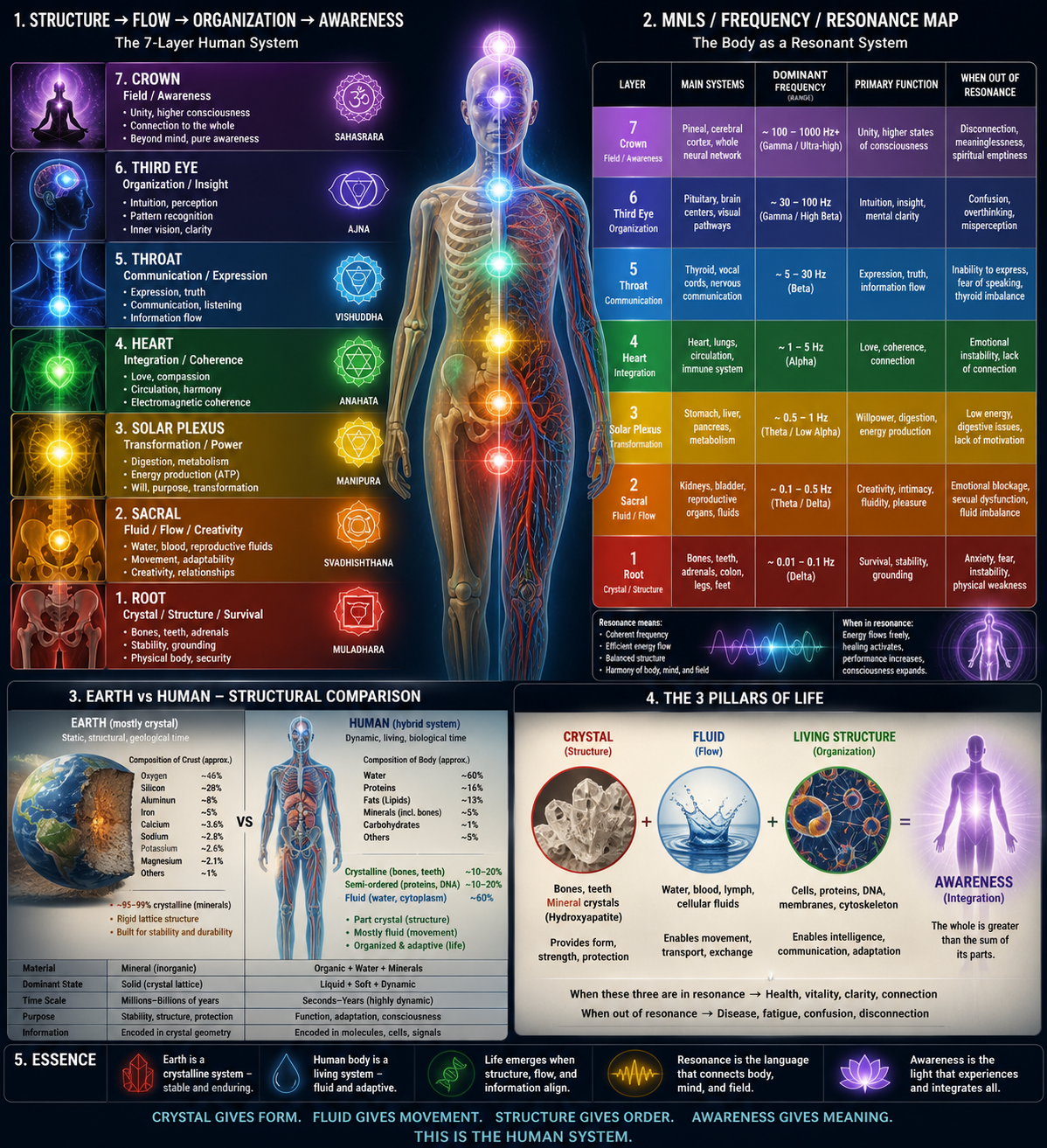
We can take the idea of the crystallinity of the body and apply it to the energetic cakra body. The comparison between the structure of the human body and the cakra energy system can be understood as a layered model that moves from physical matter to awareness. Rather than seeing the cakras as abstract or separate from the body, they can be interpreted as a way of describing how different levels of organization—structure, flow, energy, communication, and perception—work together within a living system.
When viewed this way, the cakra model becomes a symbolic map of increasing complexity and integration, beginning with physical stability and culminating in awareness.
At the foundation of this system is the root cakra, which corresponds to structure. Physically, this is represented by bones and teeth, the most rigid and mineralized parts of the body. These are composed largely of crystalline materials, providing stability, support, and protection. In this sense, the root layer mirrors the Earth’s crust, which is also predominantly crystalline. Both serve as a stable base, a fixed geometry upon which everything else depends. Without this structural layer, neither the planet nor the body could maintain form.
Above this is the sacral cakra, associated with fluid and movement. The human body is composed of roughly sixty percent water, and this fluid medium allows for circulation, transport, and exchange. Blood carries oxygen and nutrients, lymph moves immune cells, and intracellular fluids support cellular processes. This layer represents the transition from static structure to dynamic flow. Unlike the rigid crystalline base, the fluid system enables adaptability and responsiveness, making life possible.
The next level, often associated with the navel/solar plexus cakrfa, represents transformation. Here, the body converts matter into energy through metabolic processes. Digestion breaks down food, and cellular respiration generates ATP, the energy currency of the cell. Chemically, this involves interactions between elements such as hydrogen and oxygen, releasing energy that powers all biological activity. At this stage, the system is no longer just structured or flowing—it is actively transforming and generating usable energy.
The heart cakra represents integration. The circulatory system distributes energy and resources throughout the body, while the heart itself maintains a rhythmic coordination that synchronizes bodily processes. This level can be understood as the point at which the different systems of the body begin to function as a unified whole. Rather than isolated processes, there is coherence—each part supporting and regulating the others.
Above this is the throat cakra, associated with communication. In biological terms, this corresponds to the nervous system and hormonal signaling. Electrical impulses travel through neurons, and chemical signals are released into the bloodstream, allowing different parts of the body to exchange information. At this level, the system gains the ability to coordinate actions across distances, turning integration into intelligent responsiveness.
The sixth cakra, often linked to the third eye, represents organization and perception. The brain processes incoming information, identifies patterns, and constructs an internal model of reality. This is where raw signals become meaningful, and where the system begins to interpret itself and its environment. It is not merely reacting but understanding, organizing experience into coherent patterns.
Finally, the crown cakra represents awareness. Unlike the previous layers, this is not tied to a specific physical structure. Instead, it emerges from the integration of all the lower levels. When structure, flow, energy, communication, and perception are functioning together, the result is conscious experience. Awareness can be seen as the highest level of organization, where the system becomes capable of reflecting on itself.
Taken together, this layered model describes a progression: from crystal-like structure to fluid movement, from energy transformation to system-wide integration, from communication to perception, and ultimately to awareness. It reflects a shift from fixed geometry to dynamic organization, and finally to self-awareness.
In this sense, the human body can be understood as more than just physical matter. It is a multi-layered system in which each level builds upon the previous one. The crystalline structure of the bones provides form, the fluid systems enable movement, biochemical processes generate energy, communication systems coordinate activity, and higher-order processes create meaning and awareness.
The cakra framework, when interpreted in this grounded way, becomes a symbolic representation of how complexity emerges from structure, and how life evolves from matter into conscious experience.